https://orcid.org/0000-0001-7679-6023






La investigación en Ciencias Veterinarias atraviesa un periodo de profunda expansión metodológica. Historias clínicas electrónicas, imágenes diagnósticas, registros productivos, dispositivos portátiles, sensores ambientales, datos genómicos y sistemas de vigilancia epidemiológica generan volúmenes de información que difícilmente pueden estudiarse mediante procedimientos manuales. Este escenario ha favorecido la incorporación de herramientas de inteligencia artificial capaces de reconocer patrones, clasificar observaciones, estimar riesgos y apoyar el análisis de problemas complejos relacionados con la salud, la producción y el bienestar animal.
Sin embargo, disponer de algoritmos cada vez más sofisticados no garantiza investigaciones científicamente sólidas. Un modelo predictivo puede alcanzar métricas aparentemente sobresalientes y, aun así, carecer de utilidad clínica o biológica. También puede aprender sesgos de selección, aprovechar información disponible únicamente después del desenlace, confundir características del centro veterinario con señales de enfermedad o producir probabilidades mal calibradas. La capacidad computacional no compensa una pregunta imprecisa, una muestra inadecuada, la pseudorreplicación, la ausencia de controles o una definición deficiente de la variable de resultado.
Esta obra parte de una premisa esencial: la inteligencia artificial debe integrarse al método científico y permanecer subordinada a sus principios. No constituye un procedimiento alternativo para generar conocimiento ni reemplaza la metodología de la investigación, la bioestadística, el diseño experimental o el juicio profesional. Su aporte depende de la calidad de los datos, de la coherencia entre la pregunta y el diseño, de la selección razonada del método analítico y de la interpretación crítica de los resultados.
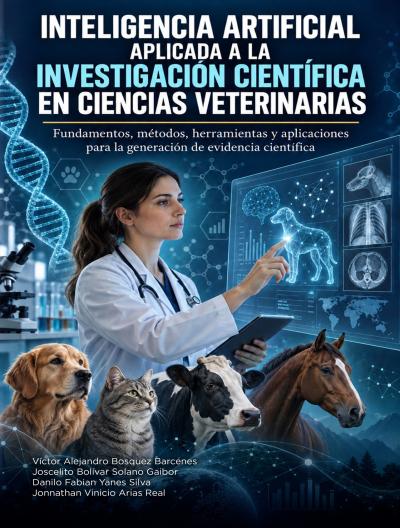
Inteligencia Artificial Aplicada a la Investigación Científica en Ciencias Veterinarias: Fundamentos, métodos, herramientas y aplicaciones para la generación de evidencia científica fue concebido para estudiantes universitarios, docentes, investigadores, médicos veterinarios y profesionales de las ciencias animales interesados en comprender estas tecnologías sin perder de vista la realidad clínica, productiva y epidemiológica en la que serán utilizadas. El libro no presenta la inteligencia artificial como una colección de soluciones automáticas. La examina como un conjunto de métodos cuyo valor debe demostrarse frente a alternativas más sencillas, prácticas profesionales existentes y necesidades concretas de animales, responsables, productores y comunidades.
Los primeros capítulos establecen las bases conceptuales necesarias para diferenciar inteligencia artificial, aprendizaje automático, aprendizaje profundo, procesamiento del lenguaje natural e inteligencia artificial generativa. Esta distinción evita denominar inteligencia artificial a cualquier análisis computacional y permite reconocer qué tipo de problema puede resolverse mediante cada enfoque. También se analiza la relación entre descripción, inferencia, predicción y causalidad, conceptos que suelen confundirse cuando el rendimiento algorítmico se interpreta como explicación biológica.
La conexión con el método científico ocupa un lugar central. El texto recorre la delimitación del problema, la formulación de preguntas e hipótesis, la revisión de literatura, la planificación de la recolección de datos, la selección del diseño, el cálculo del tamaño muestral y la definición del análisis. De este modo, la inteligencia artificial se incorpora dentro de una secuencia de decisiones científicas y no como una intervención aislada al final del estudio.
El tratamiento del diseño experimental resulta especialmente pertinente para las Ciencias Veterinarias. En esta disciplina conviven animales, muestras biológicas, lesiones, imágenes, mediciones repetidas, corrales, hatos, explotaciones, hospitales y regiones. Identificar correctamente la unidad experimental y la unidad observacional es indispensable para evitar inferencias artificialmente precisas. La aleatorización, el bloqueo, el enmascaramiento, los controles, las réplicas independientes y el manejo de factores de confusión conservan toda su importancia cuando se emplean modelos de aprendizaje automático. Ningún algoritmo puede reconstruir la validez perdida por un experimento mal diseñado.
El libro dedica una atención cuidadosa a la gestión y preparación de los datos. Los registros veterinarios contienen valores faltantes, mediciones realizadas con diferentes equipos, errores de codificación, categorías poco frecuentes y observaciones dependientes. Las historias clínicas agregan abreviaturas, negaciones, expresiones locales y variaciones en la documentación profesional. Las imágenes dependen de la técnica de adquisición, la posición del animal, el operador y el equipo utilizado. Por ello, la limpieza, la trazabilidad, la imputación, la normalización, el control de calidad y la prevención de fugas de información se presentan como componentes sustantivos de la investigación.
La exposición de los modelos mantiene una orientación comparativa. Regresión lineal y logística, árboles de decisión, random forest, gradient boosting, XGBoost, LightGBM, máquinas de vectores de soporte y métodos de vecinos cercanos son examinados según la naturaleza de la pregunta, el tamaño de la muestra, la estructura de los datos y la necesidad de interpretación. Esta organización evita la preferencia automática por algoritmos complejos y reconoce que una regresión correctamente especificada puede superar a métodos más flexibles cuando la muestra es limitada o la relación entre variables es relativamente simple.
Los capítulos sobre aprendizaje no supervisado, series temporales, visión computacional y procesamiento del lenguaje natural amplían el horizonte analítico hacia problemas frecuentes en la investigación veterinaria. La identificación de grupos clínicos, la reducción de dimensionalidad, la detección de anomalías en sensores, la predicción de variables fisiológicas, la clasificación de imágenes radiográficas y la extracción de información de historias clínicas se presentan con sus posibilidades y restricciones. En cada caso se insiste en documentar el estándar de referencia, separar adecuadamente los conjuntos de entrenamiento, validación y prueba, y evaluar el rendimiento en poblaciones diferentes de aquellas utilizadas durante el desarrollo.
La inteligencia artificial generativa recibe un tratamiento deliberadamente crítico. Los modelos de lenguaje pueden apoyar la exploración de conceptos, la formulación inicial de estrategias de búsqueda, la programación, la traducción y la revisión de la claridad de un texto. No obstante, producen respuestas a partir de regularidades estadísticas del lenguaje y no mediante una comprobación autónoma de la evidencia. Pueden inventar referencias, alterar datos, proponer análisis incompatibles con el diseño o redactar afirmaciones convincentes pero falsas. El libro establece, por tanto, una separación necesaria entre asistencia lingüística y autoridad científica. La responsabilidad sobre cada afirmación, referencia, resultado y decisión metodológica permanece en las personas autoras.
Las aplicaciones veterinarias abarcan medicina clínica, cirugía, anestesiología, evaluación del dolor, oncología, cardiología, neurología, dermatología, oftalmología, medicina regenerativa y rehabilitación. A estas áreas se suman la ganadería de precisión, la reproducción, la nutrición, la producción de leche, la avicultura, la porcicultura, la acuicultura y la evaluación automatizada del comportamiento y del bienestar animal. La epidemiología veterinaria, la vigilancia de enfermedades, la resistencia a los antimicrobianos, la inocuidad alimentaria y el enfoque One Health completan una visión que conecta al paciente individual con las poblaciones animales, los ecosistemas y la salud pública.
Los casos didácticos cumplen una función que supera la ejemplificación. En ellos se relacionan la pregunta científica, la población, la unidad experimental, las variables, el diseño, el método estadístico o algoritmo, la validación, las métricas y las limitaciones. Problemas como la predicción de mastitis bovina, la evaluación automatizada del dolor, la clasificación de radiografías caninas, la vigilancia de zoonosis y el análisis de historias clínicas permiten apreciar que el desarrollo de un modelo constituye solo una parte del proceso. Su utilidad depende de cómo se mide el desenlace, quién utilizará la predicción, en qué momento se aplicará y qué consecuencias producirán los errores.
Otro aporte relevante reside en la evaluación crítica de los modelos. Sensibilidad, especificidad, valores predictivos, área bajo la curva ROC, precisión, recall, puntuación F1, error absoluto y coeficiente de determinación se explican desde su significado clínico y biológico. La calibración, la selección de umbrales, el análisis de utilidad y la validación externa reciben la atención que merecen. Una métrica elevada no demuestra, por sí sola, que una herramienta sea segura, generalizable o beneficiosa. La evaluación debe considerar prevalencia, costos de error, incertidumbre, equidad entre subgrupos y comparación con la práctica habitual.
La ética atraviesa toda la obra. La información veterinaria puede incluir datos del responsable del animal, ubicación de explotaciones, registros económicos, resultados productivos y antecedentes clínicos. Su utilización plantea obligaciones de confidencialidad, seguridad, consentimiento y gobernanza. También deben considerarse el bienestar animal, la distribución de responsabilidades, la transparencia de los modelos y el riesgo de automatizar decisiones sin supervisión profesional suficiente.
El cierre del libro sitúa la reproducibilidad y la comunicación científica como condiciones inseparables de la calidad metodológica. Organizar datos, conservar código, registrar versiones, documentar transformaciones y utilizar guías de reporte permite que otras personas comprendan, evalúen y, cuando sea posible, reproduzcan los análisis. Los principios FAIR, la ciencia abierta y el control de versiones se analizan junto con sus límites éticos y legales. Abrir la ciencia no significa exponer información sensible; implica hacerla tan accesible como sea posible y tan protegida como resulte necesario.
Para América Latina, estos contenidos poseen una relevancia particular. La diversidad productiva, las diferencias en infraestructura, la limitada interoperabilidad de los sistemas y la escasez de conjuntos de datos representativos exigen modelos adaptados al contexto. Importar un algoritmo entrenado en otra población, especie, sistema productivo o red hospitalaria sin validación local puede generar conclusiones equivocadas. El desarrollo regional requiere fortalecer competencias en metodología, estadística, programación, gestión de datos y evaluación crítica, además de promover colaboraciones que respeten la soberanía y la diversidad de la información veterinaria.
Este libro invita a trabajar con inteligencia artificial desde una posición científica exigente. Su mensaje no consiste en rechazar la innovación ni en aceptarla por entusiasmo tecnológico. Propone formular mejores preguntas, diseñar estudios defendibles, utilizar métodos proporcionales al problema, interpretar los resultados con prudencia y evaluar si la herramienta mejora realmente la generación de evidencia o la atención de los animales.
La inteligencia artificial encontrará un espacio legítimo en las Ciencias Veterinarias cuando sus resultados sean verificables, reproducibles, clínicamente pertinentes y éticamente responsables. Alcanzar ese objetivo depende menos del prestigio del algoritmo que de la calidad del razonamiento científico que orienta su uso. Esa es la perspectiva que articula las páginas siguientes y la que convierte esta obra en una guía académica oportuna para investigar, enseñar y tomar decisiones en una disciplina cada vez más vinculada con los datos.
Adisasmito, W. B., Almuhairi, S., Behravesh, C. B., Bilivogui, P., Bukachi, S. A., Casas, N., Cediel Becerra, N., Charron, D. F., Chaudhary, A., Ciacci Zanella, J. R., Cunningham, A. A., Dar, O., Debnath, N., Dungu, B., Farag, E., Gao, G. F., Hayman, D. T. S., Khaitsa, M., Koopmans, M. P. G., … Zhou, L. (2022). One Health: A new definition for a sustainable and healthy future. PLOS Pathogens, 18(6), e1010537. https://doi.org/10.1371/journal.ppat.1010537
Aguilar-Lazcano, C. A., Espinosa-Curiel, I. E., Ríos-Martínez, J. A., Madera-Ramírez, F. A., & Pérez-Espinosa, H. (2023). Machine learning-based sensor data fusion for animal monitoring: Scoping review. Sensors, 23(12), 5732. https://doi.org/10.3390/s23125732
Akinsulie, O. C., Idris, I., Aliyu, V. A., Shahzad, S., Banwo, O. G., Ogunleye, S. C., Olorunshola, M., Okedoyin, D. O., Ugwu, C., Oladapo, I. P., Gbadegoye, J. O., Akande, Q. A., Babawale, P., Rostami, S., & Soetan, K. O. (2024). The potential application of artificial intelligence in veterinary clinical practice and biomedical research. Frontiers in Veterinary Science, 11, 1347550. https://doi.org/10.3389/fvets.2024.1347550
Alonso Sousa, S., Bukhari, S. S. U. H., Steagall, P. V., Bęczkowski, P. M., Giuliano, A., & Flay, K. J. (2025). Performance of large language models on veterinary undergraduate multiple-choice examinations: A comparative evaluation. Frontiers in Veterinary Science, 12, 1616566. https://doi.org/10.3389/fvets.2025.1616566
Alsahaf, A., Gheorghe, R., Hidalgo, A. M., Petkov, N., & Azzopardi, G. (2023). Pre-insemination prediction of dystocia in dairy cattle. Preventive Veterinary Medicine, 210, 105812. https://doi.org/10.1016/j.prevetmed.2022.105812
Antonucci, F., & Costa, C. (2020). Precision aquaculture: A short review on engineering innovations. Aquaculture International, 28, 41–57. https://doi.org/10.1007/s10499-019-00443-w
Appleby, R. B., & Basran, P. S. (2022). Artificial intelligence in veterinary medicine. Journal of the American Veterinary Medical Association, 260(8), 819–824. https://doi.org/10.2460/javma.22.03.0093
Appleby, R. B., DiFazio, M., Cassel, N., Hennessey, R., & Basran, P. S. (2025). American College of Veterinary Radiology and European College of Veterinary Diagnostic Imaging position statement on artificial intelligence. Journal of the American Veterinary Medical Association, 263(6), 773–776. https://doi.org/10.2460/javma.25.01.0027
Asamblea Nacional del Ecuador. (2021). Ley Orgánica de Protección de Datos Personales. Registro Oficial, Quinto Suplemento No. 459, 26 de mayo de 2021. https://www.asambleanacional.gob.ec/es/multimedios-legislativos/63464-ley-organica-de-proteccion-de-datos
Banzato, T., Wodzinski, M., Burti, S., Osti, V. L., Rossoni, V., Atzori, M., & Zotti, A. (2021). Automatic classification of canine thoracic radiographs using deep learning. Scientific Reports, 11, 3964. https://doi.org/10.1038/s41598-021-83515-3
Banzato, T., Wodzinski, M., Burti, S., Vettore, E., Muller, H., & Zotti, A. (2023). An AI-based algorithm for the automatic evaluation of image quality in canine thoracic radiographs. Scientific Reports, 13, 17024. https://doi.org/10.1038/s41598-023-44089-4
Bao, J., & Xie, Q. (2022). Artificial intelligence in animal farming: A systematic literature review. Journal of Cleaner Production, 331, 129956. https://doi.org/10.1016/j.jclepro.2021.129956
Barker, M., Chue Hong, N. P., Katz, D. S., Lamprecht, A.-L., Martinez-Ortiz, C., Psomopoulos, F., Harrow, J., Castro, L. J., Gruenpeter, M., Martinez, P. A., & Honeyman, T. (2022). Introducing the FAIR Principles for research software. Scientific Data, 9, 622. https://doi.org/10.1038/s41597-022-01710-x
Basran, P. S., & Appleby, R. B. (2022). The unmet potential of artificial intelligence in veterinary medicine. American Journal of Veterinary Research, 83(5), 385–392. https://doi.org/10.2460/ajvr.22.03.0038
Basran, P. S., & Appleby, R. B. (2024). What’s in the box? A toolbox for safe deployment of artificial intelligence in veterinary medicine. Journal of the American Veterinary Medical Association, 262(8), 1090–1098. https://doi.org/10.2460/javma.24.01.0027
Bellamy, J. E. C. (2023). Artificial intelligence in veterinary medicine requires regulation. Canadian Veterinary Journal, 64(10), 968–970. https://pmc.ncbi.nlm.nih.gov/articles/PMC10506349/
Bender, E. M., Gebru, T., McMillan-Major, A., & Shmitchell, S. (2021). On the dangers of stochastic parrots: Can language models be too big? Proceedings of the 2021 ACM Conference on Fairness, Accountability, and Transparency, 610–623. https://doi.org/10.1145/3442188.3445922
Berckmans, D. (2017). General introduction to precision livestock farming. Animal Frontiers, 7(1), 6–11. https://doi.org/10.2527/af.2017.0102
Bertout, J. A., Baneux, P. J. R., & Robertson-Plouch, C. K. (2021). Recommendations for ethical review of veterinary clinical trials. Frontiers in Veterinary Science, 8, 715926. https://doi.org/10.3389/fvets.2021.715926
Bertram, C. A., Donovan, T. A., Tecilla, M., Bartenschlager, F., Fragoso, M., Wilm, F., Marzahl, C., Breininger, K., Maier, A., Klopfleisch, R., & Aubreville, M. (2021). Dataset on bi- and multi-nucleated tumor cells in canine cutaneous mast cell tumors. In Bildverarbeitung für die Medizin 2021. Springer Vieweg. https://doi.org/10.1007/978-3-658-33198-6_33
Bobbo, T., Biffani, S., Taccioli, C., Penasa, M., & Cassandro, M. (2021). Comparison of machine learning methods to predict udder health status based on somatic cell counts in dairy cows. Scientific Reports, 11, 13642. https://doi.org/10.1038/s41598-021-93056-4
Boguslav, M. R., Kiehl, A., Kott, D., Strecker, G. J., Webb, T. L., Saklou, N., Ward, T., & Kirby, M. (2026). Fine-tuning foundational models to code diagnoses from veterinary health records. PLOS Digital Health, 5(2), e0001147. https://doi.org/10.1371/journal.pdig.0001147
Bouhali, O., Bensmail, H., Sheharyar, A., David, F., & Johnson, J. P. (2022). A review of radiomics and artificial intelligence and their application in veterinary diagnostic imaging. Veterinary Sciences, 9(11), 620. https://doi.org/10.3390/vetsci9110620
Bovo, M., Agrusti, M., Benni, S., Torreggiani, D., & Tassinari, P. (2021). Random forest modelling of milk yield of dairy cows under heat stress conditions. Animals, 11(5), 1305. https://doi.org/10.3390/ani11051305
Breiman, L. (2001). Random forests. Machine Learning, 45, 5–32. https://doi.org/10.1023/A:1010933404324
Bryan, J. (2018). Excuse me, do you have a moment to talk about version control? The American Statistician, 72(1), 20–27. https://doi.org/10.1080/00031305.2017.1399928
Burton, J., Farrell, S., Mäntylä Noble, P.-J., & Al Moubayed, N. (2024). Explainable text-tabular models for predicting mortality risk in companion animals. Scientific Reports, 14, 14217. https://doi.org/10.1038/s41598-024-64551-1
Buschi, D., Curti, N., Cola, V., Carlini, G., Sala, C., Dall’Olio, D., Castellani, G., Pizzi, E., Del Magno, S., Foglia, A., Giunti, M., Pisoni, L., & Giampieri, E. (2023). Automated wound image segmentation: Transfer learning from human to pet via active semi-supervised learning. Animals, 13(6), 956. https://doi.org/10.3390/ani13060956
Cabezas, J., Yubero, R., Visitación, B., Navarro-García, J., Algar, M. J., Cano, E. L., & Ortega, F. (2022). Analysis of accelerometer and GPS data for cattle behaviour identification and anomalous events detection. Entropy, 24(3), 336. https://doi.org/10.3390/e24030336
Carlson, C. J., Albery, G. F., Merow, C., Trisos, C. H., Zipfel, C. M., Eskew, E. A., Olival, K. J., Ross, N., & Bansal, S. (2022). Climate change increases cross-species viral transmission risk. Nature, 607, 555-562. https://doi.org/10.1038/s41586-022-04788-w
Catalano, S., Battelli, F., Traore, Z. I., Raghwani, J., Faust, C. L., & Standley, C. J. (2024). Pathogen genomics and One Health: A scoping review of current practices in zoonotic disease research. IJID One Health, 4, 100031. https://doi.org/10.1016/j.ijidoh.2024.100031
Chawla, N. V., Bowyer, K. W., Hall, L. O., & Kegelmeyer, W. P. (2002). SMOTE: Synthetic minority over-sampling technique. Journal of Artificial Intelligence Research, 16, 321–357. https://doi.org/10.1613/jair.953
Chen, L., Thorup, V. M., Kudahl, A. B., & Østergaard, S. (2024). Effects of heat stress on feed intake, milk yield, milk composition, and feed efficiency in dairy cows: A meta-analysis. Journal of Dairy Science, 107(5), 3207–3218. https://doi.org/10.3168/jds.2023-24059
Chen, T., & Guestrin, C. (2016). XGBoost: A scalable tree boosting system. In Proceedings of the 22nd ACM SIGKDD International Conference on Knowledge Discovery and Data Mining (pp. 785–794). Association for Computing Machinery. https://doi.org/10.1145/2939672.2939785
Chu, C. P. (2024). ChatGPT in veterinary medicine: A practical guidance of generative artificial intelligence in clinics, education, and research. Frontiers in Veterinary Science, 11, 1395934. https://doi.org/10.3389/fvets.2024.1395934
Coghlan, S., & Quinn, T. (2023). Ethics of using artificial intelligence in veterinary medicine. AI & Society, 39, 2337–2348. https://doi.org/10.1007/s00146-023-01686-1
Cohen, E. B., & Gordon, I. K. (2022). First, do no harm: Ethical and legal issues of artificial intelligence and machine learning in veterinary radiology and radiation oncology. Veterinary Radiology & Ultrasound, 63(Suppl. 1), 840–850. https://doi.org/10.1111/vru.13171
Collins, G. S., Moons, K. G. M., Dhiman, P., Riley, R. D., Beam, A. L., Van Calster, B., Ghassemi, M., Liu, X., Reitsma, J. B., van Smeden, M., Boulesteix, A.-L., Camaradou, J. C., Celi, L. A., Denaxas, S., Denniston, A. K., Glocker, B., Golub, R. M., Harvey, H., Heinze, G., … Logullo, P. (2024). TRIPOD+AI statement: Updated guidance for reporting clinical prediction models that use regression or machine learning methods. BMJ, 385, e078378. https://doi.org/10.1136/bmj-2023-078378
Cortes, C., & Vapnik, V. (1995). Support-vector networks. Machine Learning, 20, 273–297. https://doi.org/10.1007/BF00994018
Cruz Rivera, S., Liu, X., Chan, A.-W., Denniston, A. K., Calvert, M. J., & SPIRIT-AI and CONSORT-AI Working Group. (2020). Guidelines for clinical trial protocols for interventions involving artificial intelligence: The SPIRIT-AI extension. Nature Medicine, 26(9), 1351–1363. https://doi.org/10.1038/s41591-020-1037-7
Curti, P. F., Selli, A., Pinto, D. L., Merlos-Ruiz, A., Balieiro, J. C. C., & Ventura, R. V. (2023). Applications of livestock monitoring devices and machine learning algorithms in animal production and reproduction: An overview. Animal Reproduction, 20(2), e20230077. https://doi.org/10.1590/1984-3143-AR2023-0077
Davies, H., Nenadic, G., Alfattni, G., Arguello Casteleiro, M., Al Moubayed, N., Farrell, S., Radford, A. D., & Noble, P.-J. M. (2024). Text mining for disease surveillance in veterinary clinical data: Part two, training computers to identify features in clinical text. Frontiers in Veterinary Science, 11, 1352726. https://doi.org/10.3389/fvets.2024.1352726
Davies, H., Noble, P.-J. M., Fins, I. S., Pinchbeck, G., Singleton, D., Pirmohamed, M., & Killick, D. (2025). Developing electronic health records as a source of real-world data for veterinary pharmacoepidemiology. Frontiers in Veterinary Science, 12, 1550468. https://doi.org/10.3389/fvets.2025.1550468
Devlin, J., Chang, M.-W., Lee, K., & Toutanova, K. (2019). BERT: Pre-training of deep bidirectional transformers for language understanding. Proceedings of NAACL-HLT 2019, 4171–4186. https://doi.org/10.18653/v1/N19-1423
Dosovitskiy, A., Beyer, L., Kolesnikov, A., Weissenborn, D., Zhai, X., Unterthiner, T., Dehghani, M., Minderer, M., Heigold, G., Gelly, S., Uszkoreit, J., & Houlsby, N. (2021). An image is worth 16×16 words: Transformers for image recognition at scale. Proceedings of the International Conference on Learning Representations.
European Commission. (2026). AI Act. Shaping Europe’s digital future. https://digital-strategy.ec.europa.eu/en/policies/regulatory-framework-ai
European Food Safety Authority & European Centre for Disease Prevention and Control. (2024). The European Union summary report on antimicrobial resistance in zoonotic and indicator bacteria from humans, animals and food in 2021-2022. EFSA Journal, 22(2), e8583. https://doi.org/10.2903/j.efsa.2024.8583
European Medicines Agency. (2022). European veterinary big data strategy 2022–2027. https://www.ema.europa.eu/en/documents/other/european-veterinary-big-data-strategy-2022-2027_en.pdf
European Parliament & Council of the European Union. (2024). Regulation (EU) 2024/1689 laying down harmonised rules on artificial intelligence. Official Journal of the European Union. https://eur-lex.europa.eu/eli/reg/2024/1689/oj
Ezanno, P., Picault, S., Beaunée, G., Bailly, X., Muñoz, F., Duboz, R., Monod, H., & Guégan, J.-F. (2021). Research perspectives on animal health in the era of artificial intelligence. Veterinary Research, 52, 40. https://doi.org/10.1186/s13567-021-00902-4
Farrell, S., Appleton, C., Noble, P.-J. M., & Al Moubayed, N. (2023). PetBERT: Automated ICD-11 syndromic disease coding for outbreak detection in first opinion veterinary electronic health records. Scientific Reports, 13, 18015. https://doi.org/10.1038/s41598-023-45155-7
Festing, M. F. W. (2020). The “completely randomised” and the “randomised block” are the only experimental designs suitable for widespread use in pre-clinical research. Scientific Reports, 10, 17577. https://doi.org/10.1038/s41598-020-74538-3
Finlayson, S. G., Subbaswamy, A., Singh, K., Bowers, J., Kupke, A., Zittrain, J., Kohane, I. S., & Saria, S. (2021). The clinician and dataset shift in artificial intelligence. New England Journal of Medicine, 385(3), 283–286. https://doi.org/10.1056/NEJMc2104626
Food and Agriculture Organization of the United Nations. (2023). Safe food for everyone: FAO's work on food safety. FAO. https://www.fao.org/3/cc4347en/cc4347en.pdf
Food and Agriculture Organization of the United Nations, United Nations Environment Programme, World Health Organization, & World Organisation for Animal Health. (2022). One Health joint plan of action 2022-2026: Working together for the health of humans, animals, plants and the environment. World Health Organization. https://www.who.int/publications/i/item/9789240059139
Food and Agriculture Organization of the United Nations, United Nations Environment Programme, World Health Organization, & World Organisation for Animal Health. (2023). A quadripartite global One Health intelligence framework. FAO. https://openknowledge.fao.org/handle/20.500.14283/cc7621en
Food and Agriculture Organization of the United Nations, United Nations Environment Programme, World Health Organization, & World Organisation for Animal Health. (2025). Quadripartite guidance on One Health integrated surveillance of antimicrobial resistance and use. World Health Organization. https://www.who.int/publications/i/item/9789240109865
Food and Drug Administration. (2001). CVM GFI #85 (VICH GL9): Good clinical practice. https://www.fda.gov/regulatory-information/search-fda-guidance-documents/cvm-gfi-85-vich-gl9-good-clinical-practice
Food and Drug Administration. (2021). Artificial intelligence/machine learning (AI/ML)-based software as a medical device (SaMD) action plan. U.S. Department of Health and Human Services.
Fragoso-Garcia, M., Wilm, F., Bertram, C. A., Merz, S., Schmidt, A., Donovan, T., Fuchs-Baumgartinger, A., Bartel, A., Marzahl, C., Diehl, L., Puget, C., Maier, A., Aubreville, M., Breininger, K., & Klopfleisch, R. (2023). Automated diagnosis of 7 canine skin tumors using machine learning on H&E-stained whole slide images. Veterinary Pathology, 60(6), 865–875. https://doi.org/10.1177/03009858231189205
Frederick, C. E. (2024). Obtaining informed consent in veterinary clinical trials mini review. Frontiers in Veterinary Science, 11, 1426014. https://doi.org/10.3389/fvets.2024.1426014
Gao, C. A., Howard, F. M., Markov, N. S., Dyer, E. C., Ramesh, S., Luo, Y., & Pearson, A. T. (2023). Comparing scientific abstracts generated by ChatGPT to real abstracts with detectors and blinded human reviewers. npj Digital Medicine, 6, 75. https://doi.org/10.1038/s41746-023-00819-6
Ghassemi, M., Oakden-Rayner, L., & Beam, A. L. (2021). The false hope of current approaches to explainable artificial intelligence in health care. The Lancet Digital Health, 3(11), e745–e750. https://doi.org/10.1016/S2589-7500(21)00208-9
Gómez, Y., Stygar, A. H., Boumans, I. J. M. M., Bokkers, E. A. M., Pedersen, L. J., Niemi, J. K., Pastell, M., Manteca, X., & Llonch, P. (2021). A systematic review on validated precision livestock farming technologies for pig production and its potential to assess animal welfare. Frontiers in Veterinary Science, 8, 660565. https://doi.org/10.3389/fvets.2021.660565
Grange, Z. L., Goldstein, T., Johnson, C. K., Anthony, S., Gilardi, K., Daszak, P., Olival, K. J., O'Rourke, T., Murray, S., Olson, S. H., Togami, E., Vidal, G., Expert Panel, & Mazet, J. A. K. (2021). Ranking the risk of animal-to-human spillover for newly discovered viruses. Proceedings of the National Academy of Sciences, 118(15), e2002324118. https://doi.org/10.1073/pnas.2002324118
Grubb, T., Sager, J., Gaynor, J. S., Montgomery, E., Parker, J. A., Shafford, H., & Tearney, C. (2020). 2020 AAHA anesthesia and monitoring guidelines for dogs and cats. Journal of the American Animal Hospital Association, 56(2), 59–82. https://doi.org/10.5326/JAAHA-MS-7055
Gruen, M. E., Lascelles, B. D. X., Colleran, E., Gottlieb, A., Johnson, J., Lotsikas, P., Marcellin-Little, D., & Wright, B. (2022). 2022 AAHA pain management guidelines for dogs and cats. Journal of the American Animal Hospital Association, 58(2), 55–76. https://doi.org/10.5326/JAAHA-MS-7292
Hao, W., Zhang, K., Zhang, L., Han, M., Hao, W., Li, F., & Yang, G. (2023). TSML: A new pig behavior recognition method based on two-stream mutual learning network. Sensors, 23(11), 5092. https://doi.org/10.3390/s23115092
Health Level Seven International. (2023). FHIR Release 5. https://hl7.org/fhir/
Heinlein, M. (2026). Ethical considerations of artificial intelligence in veterinary medicine decision-making. Frontiers in Veterinary Science, 13, 1780868. https://doi.org/10.3389/fvets.2026.1780868
Hennessey, E., DiFazio, M., Hennessey, R., & Cassel, N. (2022). Artificial intelligence in veterinary diagnostic imaging: A literature review. Veterinary Radiology & Ultrasound, 63(S1), 851–870. https://doi.org/10.1111/vru.13163
Hernán, M. A., & Robins, J. M. (2020). Causal inference: What if. Chapman & Hall/CRC.
Hyndman, R. J., & Athanasopoulos, G. (2021). Forecasting: Principles and practice (3rd ed.). OTexts. https://otexts.com/fpp3/
Intergovernmental Panel on Climate Change. (2023). Climate change 2023: Synthesis report. https://doi.org/10.59327/IPCC/AR6-9789291691647
International Committee of Medical Journal Editors. (2026). Recommendations for the conduct, reporting, editing, and publication of scholarly work in medical journals: Use of artificial intelligence in publishing. https://www.icmje.org/recommendations/browse/artificial-intelligence/
International Committee of Medical Journal Editors. (2026). Use of artificial intelligence in publishing: Use of AI by authors. https://www.icmje.org/recommendations/browse/artificial-intelligence/ai-use-by-authors.html
James, G., Witten, D., Hastie, T., Tibshirani, R., & Taylor, J. (2023). An introduction to statistical learning: With applications in Python. Springer. https://doi.org/10.1007/978-3-031-38747-0
Ji, Z., Lee, N., Frieske, R., Yu, T., Su, D., Xu, Y., Ishii, E., Bang, Y., Chen, D., Dai, W., Chan, H. S., Madotto, A., & Fung, P. (2023). Survey of hallucination in natural language generation. ACM Computing Surveys, 55(12), Article 248. https://doi.org/10.1145/3571730
Jiang, B., Tang, W., Cui, L., & Deng, X. (2023). Precision livestock farming research: A global scientometric review. Animals, 13(13), 2096. https://doi.org/10.3390/ani13132096
Kapoor, S., & Narayanan, A. (2023). Leakage and the reproducibility crisis in machine-learning-based science. Patterns, 4(9), 100804. https://doi.org/10.1016/j.patter.2023.100804
Kaur, U., Malacco, V. M. R., Bai, H., Price, T. P., Datta, A., Xin, L., Senecal, A. G., Voyles, R. M., & Brito, L. F. (2023). Invited review: Integration of technologies and systems for precision animal agriculture—A case study on precision dairy farming. Journal of Animal Science, 101, skad206. https://doi.org/10.1093/jas/skad206
Ke, G., Meng, Q., Finley, T., Wang, T., Chen, W., Ma, W., Ye, Q., & Liu, T.-Y. (2017). LightGBM: A highly efficient gradient boosting decision tree. In Advances in Neural Information Processing Systems 30 (pp. 3146–3154).
Kelly, C. J., Karthikesalingam, A., Suleyman, M., Corrado, G., & King, D. (2019). Key challenges for delivering clinical impact with artificial intelligence. BMC Medicine, 17, 195. https://doi.org/10.1186/s12916-019-1426-2
Kim, J. Y., Han, M. G., Chun, J. H., Huh, E. A., & Lee, S. J. (2022). Developing a diagnosis model for dry eye disease in dogs using object detection. Scientific Reports, 12, 21351. https://doi.org/10.1038/s41598-022-25867-y
Kim, Y., Kim, J., Kim, S., Youn, H., Choi, J., & Seo, K. (2023). Machine learning-based risk prediction model for canine myxomatous mitral valve disease using electronic health record data. Frontiers in Veterinary Science, 10, 1189157. https://doi.org/10.3389/fvets.2023.1189157
Kong, C. Y., Vasquez, P., Farhoodimoghadam, M., Brandt, C., Brown, T. C., Reagan, K. L., Zwingenberger, A., & Keller, S. M. (2025). Anna: An open-source platform for real-time integration of machine learning classifiers with veterinary electronic health records. BMC Veterinary Research, 21, 557. https://doi.org/10.1186/s12917-025-05000-7
Leung, W. T. M., Rudge, J. W., & Fournié, G. (2023). Simulating contact networks for livestock disease epidemiology: A systematic review. Journal of the Royal Society Interface, 20(202), 20220890. https://doi.org/10.1098/rsif.2022.0890
Liu, X., Cruz Rivera, S., Moher, D., Calvert, M. J., Denniston, A. K., & SPIRIT-AI and CONSORT-AI Working Group. (2020). Reporting guidelines for clinical trial reports for interventions involving artificial intelligence: The CONSORT-AI extension. Nature Medicine, 26(9), 1364–1374. https://doi.org/10.1038/s41591-020-1034-x
Lundberg, S. M., & Lee, S.-I. (2017). A unified approach to interpreting model predictions. In I. Guyon, U. von Luxburg, S. Bengio, H. Wallach, R. Fergus, S. Vishwanathan, & R. Garnett (Eds.), Advances in neural information processing systems 30 (pp. 4765–4774). Curran Associates.
Luo, W., Dong, Q., & Feng, Y. (2023). Risk prediction model of clinical mastitis in lactating dairy cows based on machine learning algorithms. Preventive Veterinary Medicine, 221, 106059. https://doi.org/10.1016/j.prevetmed.2023.106059
Martínez-López, B., Díaz-Cao, J. M., Clavijo, M. J., González-Crespo, C., Gómez-Vázquez, J. P., Rupasinghe, R., & Liu, X. (2025). Toward precision veterinary epidemiology: Applications, challenges, and opportunities of digitalization and the Big Data revolution in livestock health. Journal of the American Veterinary Medical Association, 263(5), 650-657. https://doi.org/10.2460/javma.25.01.0026
McDonald, A., Novo Matos, J., Silva, J., Partington, C., Lo, E. J. Y., Luis Fuentes, V., Barron, L., Watson, P., & Agarwal, A. (2024). A machine-learning algorithm to grade heart murmurs and stage preclinical myxomatous mitral valve disease in dogs. Journal of Veterinary Internal Medicine, 38(6), 2994–3004. https://doi.org/10.1111/jvim.17224
McInnes, L., Healy, J., & Melville, J. (2018). UMAP: Uniform manifold approximation and projection. Journal of Open Source Software, 3(29), 861. https://doi.org/10.21105/joss.00861
Mongan, J., Moy, L., & Kahn, C. E., Jr. (2020). Checklist for Artificial Intelligence in Medical Imaging (CLAIM): A guide for authors and reviewers. Radiology: Artificial Intelligence, 2(2), e200029. https://doi.org/10.1148/ryai.2020200029
Monteiro, B. P., Lascelles, B. D. X., Murrell, J., Robertson, S., Steagall, P. V. M., & Wright, B. (2023). 2022 WSAVA guidelines for the recognition, assessment and treatment of pain. Journal of Small Animal Practice, 64(4), 177–254. https://doi.org/10.1111/jsap.13566
Moons, K. G. M., Damen, J. A. A. G., Kaul, T., Hooft, L., Andaur Navarro, C. L., Dhiman, P., Beam, A. L., Van Calster, B., Ghassemi, M., Liu, X., Reitsma, J. B., van Smeden, M., Boulesteix, A. L., Camaradou, J. C., Celi, L. A., Denaxas, S., Denniston, A. K., Glocker, B., Golub, R. M., … Collins, G. S. (2025). PROBAST+AI: An updated quality, risk of bias, and applicability assessment tool for prediction models using regression or artificial intelligence methods. BMJ, 388, e082505. https://doi.org/10.1136/bmj-2024-082505
Moore, S. S., Costa, A., Penasa, M., Callegaro, S., & De Marchi, M. (2023). How heat stress conditions affect milk yield, composition, and price in Italian Holstein herds. Journal of Dairy Science, 106(6), 4042–4058. https://doi.org/10.3168/jds.2022-22640
Murray, C. J. L., Ikuta, K. S., Sharara, F., Swetschinski, L., Robles Aguilar, G., Gray, A., Han, C., Bisignano, C., Rao, P., Wool, E., Johnson, S. C., Browne, A. J., Chipeta, M. G., Fell, F., Hackett, S., Haines-Woodhouse, G., Kashef Hamadani, B. H., Kumaran, E. A. P., McManigal, B., … Naghavi, M. (2022). Global burden of bacterial antimicrobial resistance in 2019: A systematic analysis. The Lancet, 399(10325), 629-655. https://doi.org/10.1016/S0140-6736(21)02724-0
National Academies of Sciences, Engineering, and Medicine. (2019). Reproducibility and replicability in science. The National Academies Press. https://doi.org/10.17226/25303
National Electrical Manufacturers Association. (n.d.). DICOM standard. Retrieved September 16, 2026, from https://www.dicomstandard.org/current
Neupane, R., Aryal, A., Haeussermann, A., Hartung, E., Pinedo, P., & Paudyal, S. (2024). Evaluating machine learning algorithms to predict lameness in dairy cattle. PLOS ONE, 19(7), e0301167. https://doi.org/10.1371/journal.pone.0301167
Niemeyer, F., Galbusera, F., Beukers, M., Jonas, R., Tao, Y., Fusellier, M., Tryfonidou, M. A., Neidlinger-Wilke, C., Kienle, A., & Wilke, H.-J. (2024). Automatic grading of intervertebral disc degeneration in lumbar dog spines. JOR Spine, 7(2), e1326. https://doi.org/10.1002/jsp2.1326
Norori, N., Hu, Q., Aellen, F. M., Faraci, F. D., & Tzovara, A. (2021). Addressing bias in big data and AI for health care: A call for open science. Patterns, 2(10), 100347. https://doi.org/10.1016/j.patter.2021.100347
O’Connor, A. M., Sargeant, J. M., Dohoo, I. R., Erb, H. N., Cevallos, M., Egger, M., Ersbøll, A. K., Martin, S. W., Nielsen, L. R., Pearl, D. L., Pfeiffer, D. U., Sanchez, J., Torrence, M. E., Vigre, H., Waldner, C., & Ward, M. P. (2016). Explanation and elaboration document for the STROBE-Vet statement: Strengthening the reporting of observational studies in epidemiology—Veterinary extension. Journal of Veterinary Internal Medicine, 30(6), 1896–1928. https://doi.org/10.1111/jvim.14592
Ojo, R. O., Ajayi, A. O., Owolabi, H. A., Oyedele, L. O., & Akanbi, L. A. (2022). Internet of Things and machine learning techniques in poultry health and welfare management: A systematic literature review. Computers and Electronics in Agriculture, 200, 107266. https://doi.org/10.1016/j.compag.2022.107266
Oren, A., Türkcü, J. D., Meller, S., Lazebnik, T., Wiegel, P., Mach, R., Volk, H. A., & Zamansky, A. (2023). BrachySound: Machine learning based assessment of respiratory sounds in dogs. Scientific Reports, 13, 20300. https://doi.org/10.1038/s41598-023-47308-0
Page, M. J., McKenzie, J. E., Bossuyt, P. M., Boutron, I., Hoffmann, T. C., Mulrow, C. D., Shamseer, L., Tetzlaff, J. M., Akl, E. A., Brennan, S. E., Chou, R., Glanville, J., Grimshaw, J. M., Hróbjartsson, A., Lalu, M. M., Li, T., Loder, E. W., Mayo-Wilson, E., McDonald, S., … Moher, D. (2021). The PRISMA 2020 statement: An updated guideline for reporting systematic reviews. BMJ, 372, n71. https://doi.org/10.1136/bmj.n71
Pang, G., Shen, C., Cao, L., & van den Hengel, A. (2021). Deep learning for anomaly detection: A review. ACM Computing Surveys, 54(2), Article 38. https://doi.org/10.1145/3439950
Papakonstantinou, G. I., Voulgarakis, N., Terzidou, G., Fotos, L., Giamouri, E., & Papatsiros, V. G. (2024). Precision livestock farming technology: Applications and challenges of animal welfare and climate change. Agriculture, 14(4), 620. https://doi.org/10.3390/agriculture14040620
Parsons, I. L., Karisch, B. B., Stone, A. E., Webb, S. L., Norman, D. A., Street, G. M., & Dillard, S. L. (2024). Machine learning methods and visual observations to categorize behavior of grazing cattle using accelerometer signals. Sensors, 24(10), 3171. https://doi.org/10.3390/s24103171
Penev, Y. P. (2024). Electronic health record data quality and performance assessments: Scoping review. JMIR Medical Informatics, 12, e58130. https://doi.org/10.2196/58130
Percie du Sert, N., Ahluwalia, A., Alam, S., Avey, M. T., Baker, M., Browne, W. J., Clark, A., Cuthill, I. C., Dirnagl, U., Emerson, M., Garner, P., Holgate, S. T., Howells, D. W., Hurst, V., Karp, N. A., Lazic, S. E., Lidster, K., MacCallum, C. J., Macleod, M., & Petersen, O. H. (2020b). Reporting animal research: Explanation and elaboration for the ARRIVE guidelines 2.0. PLOS Biology, 18(7), e3000411. https://doi.org/10.1371/journal.pbio.3000411
Percie du Sert, N., Hurst, V., Ahluwalia, A., Alam, S., Avey, M. T., Baker, M., Browne, W. J., Clark, A., Cuthill, I. C., Dirnagl, U., Emerson, M., Garner, P., Holgate, S. T., Howells, D. W., Karp, N. A., Lazic, S. E., Lidster, K., MacCallum, C. J., Macleod, M., … Würbel, H. (2020a). The ARRIVE guidelines 2.0: Updated guidelines for reporting animal research. PLOS Biology, 18(7), e3000410. https://doi.org/10.1371/journal.pbio.3000410
Pillai, N., Ramkumar, M., & Nanduri, B. (2022). Artificial intelligence models for zoonotic pathogens: A survey. Microorganisms, 10(10), 1911. https://doi.org/10.3390/microorganisms10101911
Piper, S. K., Zocholl, D., Toelch, U., Roehle, R., Stroux, A., Hoessler, J., Zinke, A., & Konietschke, F. (2023). Statistical review of animal trials—A guideline. Biometrical Journal, 65(2), 2200061. https://doi.org/10.1002/bimj.202200061
Presidencia de la República del Ecuador. (2023). Reglamento General a la Ley Orgánica de Protección de Datos Personales (Decreto Ejecutivo No. 904). Registro Oficial, Tercer Suplemento No. 435, 13 de noviembre de 2023. https://www.telecomunicaciones.gob.ec/reglamento-ley-organica-de-proteccion-de-datos-personales/
Reagan, K. L., Deng, S., Sheng, J., Sebastian, J., Wang, Z., Huebner, S. N., Wenke, L. A., Michalak, S. R., Strohmer, T., & Sykes, J. E. (2022). Use of machine-learning algorithms to aid in the early detection of leptospirosis in dogs. Journal of Veterinary Diagnostic Investigation, 34(4), 612–621. https://doi.org/10.1177/10406387221096781
Redondo, J. I., Rubio, M., Soler, G., Serra, I., Soler, C., & Gómez-Villamandos, R. J. (2024). Anaesthetic mortality in dogs: A worldwide analysis and risk assessment. Veterinary Record, 194, e3604. https://doi.org/10.1002/vetr.3604
Regenstrief Institute. (n.d.). LOINC: The international standard for identifying health measurements, observations, and documents. Retrieved September 16, 2026, from https://loinc.org/
Rethlefsen, M. L., Kirtley, S., Waffenschmidt, S., Ayala, A. P., Moher, D., Page, M. J., Koffel, J. B., & PRISMA-S Group. (2021). PRISMA-S: An extension to the PRISMA statement for reporting literature searches in systematic reviews. Systematic Reviews, 10, 39. https://doi.org/10.1186/s13643-020-01542-z
Riley, R. D., Ensor, J., Snell, K. I. E., Harrell, F. E., Jr., Martin, G. P., Reitsma, J. B., Moons, K. G. M., Collins, G., & van Smeden, M. (2020). Calculating the sample size required for developing a clinical prediction model. BMJ, 368, m441. https://doi.org/10.1136/bmj.m441
Riley, R. D., Snell, K. I. E., Ensor, J., Burke, D. L., Harrell, F. E., Jr., Moons, K. G. M., & Collins, G. S. (2019). Minimum sample size for developing a multivariable prediction model: Part II—Binary and time-to-event outcomes. Statistics in Medicine, 38(7), 1276–1296. https://doi.org/10.1002/sim.7992
Roberts, M., Driggs, D., Thorpe, M., Gilbey, J., Yeung, M., Ursprung, S., Aviles-Rivero, A. I., Etmann, C., McCague, C., Beer, L., Weir-McCall, J. R., Teng, Z., Gkrania-Klotsas, E., Rudd, J. H. F., Sala, E., & Schönlieb, C.-B. (2021). Common pitfalls and recommendations for using machine learning to detect and prognosticate for COVID-19 using chest radiographs and CT scans. Nature Machine Intelligence, 3, 199–217. https://doi.org/10.1038/s42256-021-00307-0
Russell, S. J., & Norvig, P. (2021). Artificial intelligence: A modern approach (4th ed.). Pearson.
Saito, T., & Rehmsmeier, M. (2015). The precision-recall plot is more informative than the ROC plot when evaluating binary classifiers on imbalanced datasets. PLOS ONE, 10(3), e0118432. https://doi.org/10.1371/journal.pone.0118432
Salvi, M., Molinari, F., Iussich, S., Muscatello, L. V., Pazzini, L., Benali, S., Banco, B., Abramo, F., De Maria, R., & Aresu, L. (2021). Histopathological classification of canine cutaneous round cell tumors using deep learning: A multi-center study. Frontiers in Veterinary Science, 8, 640944. https://doi.org/10.3389/fvets.2021.640944
Sandve, G. K., Nekrutenko, A., Taylor, J., & Hovig, E. (2013). Ten simple rules for reproducible computational research. PLOS Computational Biology, 9(10), e1003285. https://doi.org/10.1371/journal.pcbi.1003285
Sargeant, J. M., O’Connor, A. M., Dohoo, I. R., Erb, H. N., Cevallos, M., Egger, M., Ersbøll, A. K., Martin, S. W., Nielsen, L. R., Pearl, D. L., Pfeiffer, D. U., Sanchez, J., Torrence, M. E., Vigre, H., Waldner, C., & Ward, M. P. (2016). Methods and processes of developing the Strengthening the Reporting of Observational Studies in Epidemiology—Veterinary (STROBE-Vet) statement. Zoonoses and Public Health, 63(8), 651–661. https://doi.org/10.1111/zph.12314
Schillings, J., Bennett, R., & Rose, D. C. (2021). Animal welfare and other ethical implications of precision livestock farming technology. CABI Agriculture and Bioscience, 2, 17. https://doi.org/10.1186/s43170-021-00037-8
Shim, H., Lee, J., Choi, S., Kim, J., Jeong, J., Cho, C., Kim, H., Kim, J.-I., Kim, J., & Eom, K. (2023). Deep learning-based diagnosis of stifle joint diseases in dogs. Veterinary Radiology & Ultrasound, 64(1), 113–122. https://doi.org/10.1111/vru.13181
Smith, A. J., Clutton, R. E., Lilley, E., Hansen, K. E. A., & Brattelid, T. (2018). PREPARE: Guidelines for planning animal research and testing. Laboratory Animals, 52(2), 135–141. https://doi.org/10.1177/0023677217724823
Sounderajah, V., Guni, A., Liu, X., Collins, G. S., Karthikesalingam, A., Markar, S. R., Golub, R. M., Denniston, A. K., Shetty, S., Moher, D., Bossuyt, P. M., Darzi, A., Ashrafian, H., & STARD-AI Steering Committee. (2025). The STARD-AI reporting guideline for diagnostic accuracy studies using artificial intelligence. Nature Medicine, 31(10), 3283–3289. https://doi.org/10.1038/s41591-025-03953-8
Steagall, P. V., Monteiro, B. P., Marangoni, S., Moussa, M., & Sautié, M. (2023). Fully automated deep learning models with smartphone applicability for prediction of pain using the Feline Grimace Scale. Scientific Reports, 13, 21584. https://doi.org/10.1038/s41598-023-49031-2
Steyerberg, E. W. (2019). Clinical prediction models: A practical approach to development, validation, and updating (2nd ed.). Springer. https://doi.org/10.1007/978-3-030-16399-0
Stimmer, L., & Kuiper, R. V. (2025). Natural language processing in veterinary pathology: A commentary on opportunities, challenges, and future directions. Veterinary Pathology. Advance online publication. https://doi.org/10.1177/03009858251343215
Stygar, A. H., Gómez, Y., Berteselli, G. V., Dalla Costa, E., Canali, E., Niemi, J. K., Llonch, P., & Pastell, M. (2021). A systematic review on commercially available and validated sensor technologies for welfare assessment of dairy cattle. Frontiers in Veterinary Science, 8, 634338. https://doi.org/10.3389/fvets.2021.634338
Szlosek, D., Coyne, M., Riggott, J., Knight, K., McCrann, D. J., & Kincaid, D. (2024). Development and validation of a machine learning model for clinical wellness visit classification in cats and dogs. Frontiers in Veterinary Science, 11, 1348162. https://doi.org/10.3389/fvets.2024.1348162
Tabassi, E. (2023). Artificial intelligence risk management framework (AI RMF 1.0) (NIST AI 100-1). National Institute of Standards and Technology. https://doi.org/10.6028/NIST.AI.100-1
Tejani, A. S., Klontzas, M. E., Gatti, A. A., Mongan, J. T., Moy, L., Park, S. H., Kahn, C. E., & CLAIM 2024 Update Panel. (2024). Checklist for Artificial Intelligence in Medical Imaging (CLAIM): 2024 update. Radiology: Artificial Intelligence, 6(4), e240300. https://doi.org/10.1148/ryai.240300
Thompson, J. S., Green, M. J., Hyde, R., Bradley, A. J., & O’Grady, L. (2023). The use of machine learning to predict somatic cell count status in dairy cows post-calving. Frontiers in Veterinary Science, 10, 1297750. https://doi.org/10.3389/fvets.2023.1297750
Tian, H., Zhou, X., Wang, H., Xu, C., Zhao, Z., Xu, W., & Deng, Z. (2024). The prediction of clinical mastitis in dairy cows based on milk yield, rumination time, and milk electrical conductivity using machine learning algorithms. Animals, 14(3), 427. https://doi.org/10.3390/ani14030427
Tuyttens, F. A. M., Molento, C. F. M., & Benaissa, S. (2022). Twelve threats of precision livestock farming for animal welfare. Frontiers in Veterinary Science, 9, 889623. https://doi.org/10.3389/fvets.2022.889623
UNESCO. (2021). Recommendation on the ethics of artificial intelligence. https://unesdoc.unesco.org/ark:/48223/pf0000381137
UNESCO. (2021). UNESCO recommendation on open science. UNESCO.
van Buuren, S. (2018). Flexible imputation of missing data (2nd ed.). CRC Press. https://doi.org/10.1201/9780429492259
Van Calster, B., McLernon, D. J., van Smeden, M., Wynants, L., & Steyerberg, E. W. (2019). Calibration: The Achilles heel of predictive analytics. BMC Medicine, 17, 230. https://doi.org/10.1186/s12916-019-1466-7
van de Schoot, R., de Bruin, J., Schram, R., Zahedi, P., de Boer, J., Weijdema, F., Kramer, B., Huijts, M., Hoogerwerf, M., Ferdinands, G., Harkema, A., Willemsen, J., Ma, Y., Fang, Q., Hindriks, S., Tummers, L., & Oberski, D. (2021). An open source machine learning framework for efficient and transparent systematic reviews. Nature Machine Intelligence, 3(2), 125–133. https://doi.org/10.1038/s42256-020-00287-7
van Dis, E. A. M., Bollen, J., Zuidema, W., van Rooij, R., & Bockting, C. L. (2023). ChatGPT: Five priorities for research. Nature, 614, 224–226. https://doi.org/10.1038/d41586-023-00288-7
Varkoulis, K., Savvas, I., Anagnostou, T., Kazakos, G., & Pavlidou, K. (2023). A retrospective study on canine and feline mortality during anaesthesia at a university clinic in Greece. Animals, 13(15), 2486. https://doi.org/10.3390/ani13152486
Vasey, B., Nagendran, M., Campbell, B., Clifton, D. A., Collins, G. S., Denaxas, S., Denniston, A. K., Faes, L., Geerts, B., Ibrahim, M., Liu, X., Mateen, B. A., Mathur, P., McCradden, M. D., Morgan, L., Ordish, J., Rogers, C., Saria, S., Ting, D. S. W., … DECIDE-AI Expert Group. (2022). Reporting guideline for the early-stage clinical evaluation of decision support systems driven by artificial intelligence: DECIDE-AI. Nature Medicine, 28(5), 924–933. https://doi.org/10.1038/s41591-022-01772-9
Vaswani, A., Shazeer, N., Parmar, N., Uszkoreit, J., Jones, L., Gomez, A. N., Kaiser, Ł., & Polosukhin, I. (2017). Attention is all you need. Advances in Neural Information Processing Systems, 30, 5998–6008.
VeNom Coding Group. (n.d.). VeNom codes. https://www.vetxml.co.uk/venom-codes/
Veterinary Terminology Services Laboratory. (2026). Veterinary extension of SNOMED CT. Virginia-Maryland College of Veterinary Medicine. https://vtsl.vetmed.vt.edu/
Vickers, A. J., & Elkin, E. B. (2006). Decision curve analysis: A novel method for evaluating prediction models. Medical Decision Making, 26(6), 565–574. https://doi.org/10.1177/0272989X06295361
Vidal, G., Sharpnack, J., Pinedo, P., Tsai, I.-C., Lee, A. R., Martínez-López, B., & Aly, S. S. (2023). Impact of sensor data pre-processing strategies and selection of machine learning algorithm on the prediction of metritis events in dairy cattle. Preventive Veterinary Medicine, 214, 105903. https://doi.org/10.1016/j.prevetmed.2023.105903
Villarino, N. F. (2025). Recommendations for a complete reporting of statistical methods in veterinary pharmacology. Journal of Veterinary Pharmacology and Therapeutics, 48(4), 221–233. https://doi.org/10.1111/jvp.70001
Walker, M. A., Tan, L. M., Dang, L. H., Van Khang, P., Ha, H. T. T., & Blackburn, J. K. (2022). Spatiotemporal patterns of anthrax, Vietnam, 1990–2015. Emerging Infectious Diseases, 28(11), 2206–2213. https://doi.org/10.3201/eid2811.212584
Wang, Z., Cao, Q., Liu, Q., Dufe, D., Wouters, P., Deng, L., & Pong, A. (2025). How many subjects are enough in a veterinary trial? Literature review and insights from industrial statisticians. Research in Veterinary Science, 186, 105569. https://doi.org/10.1016/j.rvsc.2025.105569
Wasserstein, R. L., & Lazar, N. A. (2016). The ASA statement on p-values: Context, process, and purpose. The American Statistician, 70(2), 129–133. https://doi.org/10.1080/00031305.2016.1154108
Weng, H. Y., & Messam, L. L. M. (2025). Reporting and interpreting statistical results in veterinary medicine: Calling for change. Journal of Veterinary Internal Medicine, 39(1), e17258. https://doi.org/10.1111/jvim.17258
Wilkinson, M. D., Dumontier, M., Aalbersberg, I. J., Appleton, G., Axton, M., Baak, A., Blomberg, N., Boiten, J.-W., da Silva Santos, L. B., Bourne, P. E., Bouwman, J., Brookes, A. J., Clark, T., Crosas, M., Dillo, I., Dumon, O., Edmunds, S., Evelo, C. T., Finkers, R., … Mons, B. (2016). The FAIR Guiding Principles for scientific data management and stewardship. Scientific Data, 3, 160018. https://doi.org/10.1038/sdata.2016.18
Wilson, G., Bryan, J., Cranston, K., Kitzes, J., Nederbragt, L., & Teal, T. K. (2017). Good enough practices in scientific computing. PLOS Computational Biology, 13(6), e1005510. https://doi.org/10.1371/journal.pcbi.1005510
World Health Organization. (2021). Ethics and governance of artificial intelligence for health: WHO guidance. https://www.who.int/publications/i/item/9789240029200
World Health Organization. (2022). Global antimicrobial resistance and use surveillance system GLASS report 2022. World Health Organization. https://www.who.int/publications/i/item/9789240062702
World Health Organization. (2024). Ethics and governance of artificial intelligence for health: Guidance on large multi-modal models. https://www.who.int/publications/i/item/9789240084759
World Organisation for Animal Health. (2024). Annual report on antimicrobial agents intended for use in animals. Eighth report. WOAH.
World Organisation for Animal Health. (2024). Use of animals in research and education (Chapter 7.8). In Terrestrial Animal Health Code. https://www.woah.org/fileadmin/Home/eng/Health_standards/tahc/2024/en_chapitre_aw_research_education.htm
Wulcan, J. M., Jacques, K. L., Lee, M. A., Kovacs, S. L., Dausend, N., Prince, L. E., Wulcan, J., Marsilio, S., & Keller, S. M. (2025). Classification performance and reproducibility of GPT-4 omni for information extraction from veterinary electronic health records. Frontiers in Veterinary Science, 11, 1490030. https://doi.org/10.3389/fvets.2024.1490030
Xiao, S., Dhand, N. K., Wang, Z., Hu, K., Thomson, P. C., House, J. K., & Khatkar, M. S. (2025). Review of applications of deep learning in veterinary diagnostics and animal health. Frontiers in Veterinary Science, 12, 1511522. https://doi.org/10.3389/fvets.2025.1511522
Yang, L., Liu, Y., Yu, H., Fang, X., Song, L., Li, D., & Chen, Y. (2021). Computer vision models in intelligent aquaculture with emphasis on fish detection and behavior analysis: A review. Archives of Computational Methods in Engineering, 28, 2785–2816. https://doi.org/10.1007/s11831-020-09486-2
Yang, X., Bist, R. B., Paneru, B., Liu, T., Applegate, T., Ritz, C., Kim, W., Regmi, P., & Chai, L. (2024). Computer vision-based cybernetics systems for promoting modern poultry farming: A critical review. Computers and Electronics in Agriculture, 226, 109339. https://doi.org/10.1016/j.compag.2024.109339
Zielinski, C., Winker, M., Aggarwal, R., Ferris, L., Heinemann, M., Lapeña, J. F., Pai, S. A., Ing, E., Citrome, L., Alam, M., Voight, M., Habibzadeh, F., & Bazdaric, K. (2023). Chatbots, generative AI, and scholarly manuscripts: WAME recommendations on chatbots and generative artificial intelligence in relation to scholarly publications. Current Medical Research and Opinion, 40(1), 11. https://doi.org/10.1080/03007995.2023.2286102

Esta obra está bajo una licencia internacional Creative Commons Atribución-NoComercial-CompartirIgual 4.0.
No es necesario que cumpla con la licencia para los elementos del material que sean de dominio público o cuando su uso esté permitido por una excepción o limitación aplicable .
No se ofrecen garantías. La licencia podría no otorgarle todos los permisos necesarios para el uso previsto. Por ejemplo, otros derechos, como los de publicidad, privacidad o morales, podrían limitar el uso del material.