https://orcid.org/0000-0003-2873-2185






La incursión de la inteligencia artificial en la cotidianidad académica ha transformado, casi de manera silenciosa, los mecanismos mediante los cuales construimos y nos apropiamos del conocimiento. Lejos de limitarse a la adopción de nuevas aplicaciones informáticas, este fenómeno está rediseñando la arquitectura misma de las interacciones en el aula y las dinámicas de los resultados académicos. Nos encontramos ante lo que los autores de esta obra definen, con innegable agudeza, como un reto existencial: una coyuntura que exige a las instituciones universitarias replantear sus lógicas de enseñanza y sus cimientos éticos frente a la automatización.
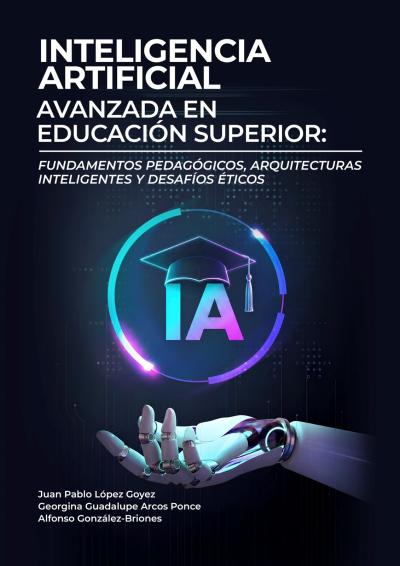
El presente libro, Inteligencia Artificial Avanzada en Educación Superior: fundamentos pedagógicos, arquitecturas inteligentes y desafíos éticos, nace precisamente de la urgencia de evitar que la tecnología se implemente de forma desordenada o como un artificio vacío. Su premisa central es contundente: el impacto formativo de la tecnología no reside en la sofisticación de sus algoritmos, sino en la profundidad de la intencionalidad pedagógica que modele su adopción.
Para articular esta visión, el manuscrito despliega un recorrido metódico organizado en tres grandes bloques, permitiendo que la teoría transite de manera natural hacia la praxis. La primera sección establece el anclaje indispensable. A través de una revisión exhaustiva de marcos como el constructivismo, el conectivismo y el aprendizaje situado, los autores demuestran que las teorías educativas no son reliquias del pasado, sino la brújula necesaria para evitar que la máquina asuma el protagonismo y termine por erosionar la autonomía intelectual del estudiante.
Una vez cimentada la base didáctica, la segunda sección aterriza el debate en la realidad operativa. Aquí se diseccionan ecosistemas tecnológicos de alta complejidad: los sistemas multi-agente, la integración en entornos virtuales de aprendizaje y las innovadoras arquitecturas de Generación Aumentada por Recuperación (RAG). Estas páginas ilustran de manera magistral cómo la inteligencia artificial generativa ha dejado de arrojar respuestas mecánicas para sostener diálogos fundamentados en fuentes verificables. El resultado es un acompañamiento tutorial dinámico, capaz de adaptarse a las disonancias y ritmos propios de cada aprendiz.
El rigor de la obra alcanza su punto culminante en la tercera sección, donde se abordan sin eufemismos los dilemas éticos y las barreras institucionales. El texto disecciona tensiones contemporáneas críticas: la opacidad algorítmica, la perpetuación de sesgos históricos en los datos, el resguardo de la privacidad y el peligro latente de una dependencia digital que anule el esfuerzo cognitivo. En este punto emerge una de las contribuciones más lúcidas del libro, la cual sostiene que la alfabetización humana integral es el requisito innegociable para mediar con la tecnología, reconfigurando jamás suprimiendo el irremplazable rol del docente.
Más que ofrecer fórmulas rígidas o respuestas cerradas ante la incertidumbre tecnológica, el lector tiene en sus manos un andamiaje doctrinal sólido. Esta obra invita a la comunidad académica a comprender que la transición hacia una universidad mediada por la inteligencia artificial demanda un equilibrio inquebrantable entre el avance computacional y nuestro compromiso ético.
Aliberti, L., D’Aniello, G., & Gaeta, M. (2026). Situation-aware recommender systems: a systematic review and framework for trustworthy recommendations. Artificial Intelligence Review, 59(3). https://doi.org/10.1007/s10462-026-11503-y
Alsharhan, A., Al-Emran, M., & Shaalan, K. (2026). From interaction to impact: Examining the role of chatbots in enhancing social sustainability using SEM-ANN approach. Computers in Human Behavior Reports, 21. https://doi.org/10.1016/j.chbr.2026.100942
Aravind, A., Swathi, A., Madhuri, J. N., Canessane, R. A., Vanisree, K. L., Muniyandy, E., & Abd El-Aziz, R. M. (2026). RoBERTa-Enhanced Actor–Critic Reinforcement Learning for Adaptive and Personalized ESL Instruction. International Journal of Advanced Computer Science and Applications, 17(1), 590 – 601. https://doi.org/10.14569/IJACSA.2026.0170156
Asghar, M. Z., Iqbal, J., Özbilen, F. M., Abedin, J., Järvenoja, H., & Widanapathirana, U. (2025). The nexus of artificial intelligence literacy collaborative knowledge practices and inclusive leadership development among higher education students in Bangladesh China Finland and Turkey. Discover Computing, 28(1). https://doi.org/10.1007/s10791-025-09695-y
Atabekova, A., Atabekov, A., & Shoustikova, T. (2026). AI-Facilitated Lecturers in Higher Education Videos as a Tool for Sustainable Education: Legal Framework, Education Theory and Learning Practice. Sustainability (Switzerland), 18(1). https://doi.org/10.3390/su18010040
Azevedo, R., Johnson, A., Chauncey, A., & Burkett, C. (2010). Self-regulated learning with MetaTutor: Advancing the science of learning with MetaCognitive tools. New science of learning: Cognition, computers and collaboration in education, 225-247.
Baker, R. S., & Hawn, A. (2022). Algorithmic Bias in Education. International Journal of Artificial Intelligence in Education, 32(4), 1052-1092.
Beale, R. (2026a). Beyond Answers: Pedagogical Design Rationale for Multi-Persona AI Tutors. Applied System Innovation, 9(1). https://doi.org/10.3390/asi9010017
Beale, R. (2026b). Beyond Answers: Pedagogical Design Rationale for Multi-Persona AI Tutors. Applied System Innovation, 9(1). https://doi.org/10.3390/asi9010017
Bian, L., & Chang, M. (2026). Design and optimization of education informatization model and intelligent recommendation system based on student perception. Discover Artificial Intelligence, 6(1). https://doi.org/10.1007/s44163-025-00727-6
Bloom, B. S. (1984). The 2 Sigma Problem: The Search for Methods of Group Instruction as Effective as One-to-One Tutoring. Educational Researcher, 13(6), 4-16. http://www.jstor.org/stable/1175554
Bouallegue, S., Omri, A., & Al-Naemi, S. (2026). Machine Learning Approaches for Early Student Performance Prediction in Programming Education. Information (Switzerland), 17(1). https://doi.org/10.3390/info17010060
Clark, R. C., & Mayer, R. E. (2016). E-Learning and the Science of Instruction: Proven Guidelines for Consumers and Designers of Multimedia Learning (4.a ed.). John Wiley & Sons. https://doi.org/10.1002/9781119239086
Cotton, D. R. E., Cotton, P. A., & Shipway, J. R. (2023). Chatting and Cheating: Ensuring Academic Integrity in the Era of ChatGPT. Innovations in Education and Teaching International, 60(6), 1-12.
Dillenbourg, P. (1999). Collaborative Learning: Cognitive and Computational Approaches. Elsevier Science & Technology Books. https://books.google.com.ec/books?id=Zq4wQgAACAAJ
Dipierro, A. R., De Witte, K., & Toma, P. (2026). Nonparametric efficiency and artificial intelligence techniques in higher education: a systematic literature review and bibliometric analysis. International Transactions in Operational Research, 33(3), 1427 – 1464. https://doi.org/10.1111/itor.70070
Downes, S. (s. f.). Connectivism and connective knowledge: Essays on meaning and learning networks.
El-Soussi, A., & Yousef, D. (2026). Ai-RACE as a Framework for Writing Assignment Design in Higher Education. Education Sciences, 16(1). https://doi.org/10.3390/educsci16010119
Fan, H., Chow, E., Lu, T., Fuh, J. Y. H., Lu, W. F., & Li, B. (2026). A unified framework for large language model-guided reinforcement learning in digital twin industrial environments. Robotics and Computer-Integrated Manufacturing, 99. https://doi.org/10.1016/j.rcim.2025.103215
Festiyed, F., Desnita, D., Natasya, Z., Fadillah, M. A., & Novitra, F. (2026). From Assistance to Autonomy: AI Integration in Structured Research-Based Learning for Higher Education. Electronic Journal of E-Learning, 24(1), 109 – 124. https://doi.org/10.34190/ejel.24.1.4416
Gong, F. (2026). Design and implementation of an intelligent educational interaction system with integrated multimodal emotion recognition and adaptive content delivery. Discover Artificial Intelligence, 6(1). https://doi.org/10.1007/s44163-025-00671-5
Hackl, V., Müller, A. E., & Sailer, M. (2026). The AI literacy heptagon: A structured approach to AI literacy in higher education. Computers and Education: Artificial Intelligence, 10. https://doi.org/10.1016/j.caeai.2026.100540
Han, S. (2026). Learner autonomy and mode selection in dual-mode chatbot: Students’ interaction patterns and learning outcomes in an online course. Computers and Education, 240. https://doi.org/10.1016/j.compedu.2025.105464
Hershkovitz, A., Tabach, M., & Lurie, L. (2025). Task-Centered Analysis of Higher Education Students’ Uses of Generative Artificial Intelligence. Education Sciences, 15(12). https://doi.org/10.3390/educsci15121676
Holmes, W., Bialik, M., & Fadel, C. (2019). Artificial Intelligence in Education: Promises and Implications for Teaching and Learning. Center for Curriculum Redesign.
Holmes, W., Bialik, M., & Fadel, C. (2022). Artificial Intelligence in Education: Promises and Implications for Teaching and Learning. Center for Curriculum Redesign.
Huang, T.-F., & Chou, S.-C. (2026). Timely introduction of AI teaching practices: an auxiliary tool for Chinese proposal writing. International Journal of Evaluation and Research in Education, 15(1), 579 – 586. https://doi.org/10.11591/ijere.v15i1.36136
Irish, A. L., Gazica, M. W., & Becerra, V. (2025). A qualitative descriptive analysis on generative artificial intelligence: bridging the gap in pedagogy to prepare students for the workplace. Discover Education, 4(1). https://doi.org/10.1007/s44217-025-00435-4
Islam, P., Sani, Y. H., Mrittika, F. A., & Rahman, R. M. (2026). Spatio-temporal adaptive fusion transformer for next POI recommendation. International Journal of Cognitive Computing in Engineering, 7, 167 – 188. https://doi.org/10.1016/j.ijcce.2025.10.010
Juárez, R., Hernández-Fernández, A., Camargo, C. B., & Molero, D. (2026). Nested Learning in Higher Education: Integrating Generative AI, Neuroimaging, and Multimodal Deep Learning for a Sustainable and Innovative Ecosystem. Sustainability (Switzerland), 18(2). https://doi.org/10.3390/su18020656
Kasneci, E., Sessler, K., Küchemann, S., Bannert, M., Dementieva, D., Fischer, F., & Kasneci, G. (2023). ChatGPT for Good? On Opportunities and Challenges of Large Language Models for Education. Learning and Individual Differences, 103, 102274.
Kop, R., & Hill, A. (2008). Connectivism: Learning Theory of the Future or Vestige of the Past? International Review of Research in Open and Distributed Learning, 9(3), 1-13.
Lai, Q. (2026). Research on the refinement of college student education management based on artificial intelligence. Discover Artificial Intelligence, 6(1). https://doi.org/10.1007/s44163-025-00651-9
López-Goyez, J. P., González-Briones, A., & Chamorro, A. F. (2025). Models of Intelligent Tutoring Systems Based on Autonomous Agents for Virtual Learning Environments: A Systematic Literature Review. Advances in Practical Applications of Agents, Multi-Agent Systems, and Digital Twins: The PAAMS Collection, 184-195. https://doi.org/https://doi.org/10.1007/978-3-031-70415-4_16
López-Goyez, J. P., González-Briones, A., & Demazeau, Y. (2026). An Adaptive Multi-Agent Architecture with Reinforcement Learning and Generative AI for Intelligent Tutoring Systems: A Moodle-Based Case Study. Applied Sciences, 16(3). https://doi.org/10.3390/app16031323
López-Goyez, J. P., González-Briones, A., & Villarreal, A. F. C. (2024). Intelligent Tutoring Systems in Smart Learning Environments for Higher Education: A Systematic Literature Review. Methodologies and Intelligent Systems for Technology Enhanced Learning, 14th International Conference, 265-276. https://doi.org/https://doi.org/10.1007/978-3-031-73538-7_24
Luckin, R. (2018). Machine Learning and Human Intelligence: The Future of Education for the 21st Century. UCL Institute of Education Press.
Luckin, R., Holmes, W., Griffiths, M., & Forcier, L. B. (2016). Intelligence Unleashed: An Argument for AI in Education. Pearson.
Marquez-Carpintero, L., Lopez-Sellers, A., & Cazorla, M. (2026). Simulation of teaching behaviours in intelligent tutoring systems: a review using large language models. Artificial Intelligence Review, 59(2). https://doi.org/10.1007/s10462-025-11464-8
Mayer, R. E. (2014). The Cambridge Handbook of Multimedia Learning (2.a ed.). Cambridge University Press.
Mo, F., Huang, J., Yang, Y., Özen, Z., Maeda, Y., & Olenchak, F. R. (2026). Undergraduate students’ learning outcomes with ChatGPT: A meta-analytic study. Computers and Education: Artificial Intelligence, 10. https://doi.org/10.1016/j.caeai.2025.100536
Moroncelli, A., Soni, V., Forgione, M., Piga, D., Spahiu, B., & Roveda, L. (2026). The duality of generative AI and reinforcement learning in robotics: A review. Information Fusion, 129. https://doi.org/10.1016/j.inffus.2025.104003
Mustapha, S. M. F. D. S. (2025). Measuring Students’ Satisfaction on an XAI-Based Mixed Initiative Tutoring System for Database Design. Applied System Innovation, 8(6). https://doi.org/10.3390/asi8060189
Najjar, N., Rouphael, M., El Hajj, M., Bitar, T., Damien, P., & Hleihel, W. (2026). Faculty Perceptions and Adoption of AI in Higher Education: Insights from Two Lebanese Universities. Education Sciences, 16(1). https://doi.org/10.3390/educsci16010055
Ninghardjanti, P., Subarno, A., Winarno, & Umam, M. C. (2026). Evaluating AI adoption among university students in Indonesia: A case study at the Department of Office Administration Education at the Universitas Sebelas Maret. Research and Practice in Technology Enhanced Learning, 21. https://doi.org/10.58459/rptel.2026.21014
Pazmiño, E. F., Benavides, E. N., & López-Goyez, J. P. (2025). Herramientas pedagógicas para la enseñanza de Multimedia: IA, digital storytelling y juegos serios. SATHIRI, 20(2), 88-105. https://doi.org/10.32645/13906925.1396
Pedraja-Rejas, L., Lazo Vega, P., & Rojas Huanca, P. (2026). Navigating Ambivalence: Artificial Intelligence and Its Impact on Student Engagement in Engineering Education. Behavioral Sciences, 16(1). https://doi.org/10.3390/bs16010011
Peng, H., Ma, S., & Spector, J. M. (2019). Personalized Adaptive Learning: An Emerging Pedagogical Approach Enabled by AI. Educational Technology & Society, 22(3), 1-3.
Petrova, M. N. (2026). Strategies for developing AI competencies in higher education. Frontiers in Education, 10. https://doi.org/10.3389/feduc.2025.1683909
Petrovic, A., & Jaksic, D. (2026). Towards Smart and Socially Integrated Learning: A Systematic Review of LMS, Social Media and Artificial Intelligence Synergies. Electronic Journal of E-Learning, 24(1), 75 – 92. https://doi.org/10.34190/ejel.24.1.4417
Piaget, J. (1970). Psychology of Intelligence. Littlefield, Adams & Co.
Pintrich, P. R. (2000). The Role of Goal Orientation in Self-Regulated Learning. En M. Boekaerts, P. Pintrich, & M. Zeidner (Eds.), Handbook of Self-Regulation (pp. 451-502). Academic Press.
Qian, K., Liu, S., Li, T., Raković, M., Li, X., Guan, R., Molenaar, I., Nawaz, S., Swiecki, Z., Yan, L., & Gašević, D. (2026). Towards reliable generative AI-driven scaffolding: Reducing hallucinations and enhancing quality in self-regulated learning support. Computers & Education, 240, 105448. https://doi.org/https://doi.org/10.1016/j.compedu.2025.105448
Roll, I., Aleven, V., McLaren, B. M., & Koedinger, K. R. (2014). Improving Students’ Help-Seeking Skills Using Metacognitive Feedback in an Intelligent Tutoring System. Learning and Instruction, 30, 11-25.
Roll, I., & Wylie, R. (2016). Evolution and Revolution in Artificial Intelligence in Education. International Journal of Artificial Intelligence in Education, 26(2), 582-599.
Rosé, C. P., & Ferschke, O. (2016). Technology Support for Discussion-Based Learning: From Computer-Supported Collaborative Learning to the Future of MOOCs. International Journal of Artificial Intelligence in Education, 26(2), 660-678.
Selwyn, N. (2022). Education and Technology: Key Issues and Debates (3.a ed.). Bloomsbury Academic.
Siemens, G. (2005). Connectivism: A Learning Theory for the Digital Age. International Journal of Instructional Technology and Distance Learning, 2(1), 3-10.
Siemens, G., & Long, P. (2011). Penetrating the Fog: Analytics in Learning and Education. EDUCAUSE Review, 46(5), 30-32.
Slade, S., & Prinsloo, P. (2019). Learning Analytics: Ethical Issues and Dilemmas. American Behavioral Scientist, 57(10), 1510-1529.
Stahl, G. (2006). Group Cognition: Computer Support for Building Collaborative Knowledge. MIT Press.
Sun, D., Ba, S., Cha, Y., Yu, J., Chiang, F.-K., Dai, H. M., & Lim, C.-P. (2026). Empowering university teachers in higher education: A generative AI-responsive competency framework. Computers and Education: Artificial Intelligence, 10. https://doi.org/10.1016/j.caeai.2026.100542
Sweller, J., Ayres, P., & Kalyuga, S. (2011). Cognitive Load Theory. Springer.
Tahir, H., Hrich, N., Boujnani, S. El, & Khaldi, M. (2026). Integrating Augmented Reality Learning Objects in Intelligent Tutoring Systems: A Conceptual Model for Engaging Learning Experiences. International Journal of Advanced Computer Science and Applications, 17(1), 250 – 259. https://doi.org/10.14569/IJACSA.2026.0170123
Tariq, R., Orozco-del-Castillo, M. G., Zamir, M. T., Ramírez-Montoya, M. S., & Wilberforce, T. (2025). Explainable artificial intelligence for predictive modeling of student stress in higher education. Scientific Reports, 15(1). https://doi.org/10.1038/s41598-025-22171-3
UNESCO. (2021). Recomendación sobre la ética de la inteligencia artificial. https://unesdoc.unesco.org/
Vandewaetere, M., Desmet, P., & Clarebout, G. (2011). The Contribution of Learner Characteristics in the Development of Adaptive Learning Environments. Computers & Education, 57(1), 1181-1193.
VanLehn, K. (2011). The Relative Effectiveness of Human Tutoring, Intelligent Tutoring Systems, and Other Tutoring Systems. Educational Psychologist, 46(4), 197-221.
Villegas-Ch, W., Buenano-Fernandez, D., Navarro, A. M., & Mera-Navarrete, A. (2025). Adaptive intelligent tutoring systems for STEM education: analysis of the learning impact and effectiveness of personalized feedback. Smart Learning Environments, 12(1). https://doi.org/10.1186/s40561-025-00389-y
Vygotsky, L. S. (1978). Mind in Society: The Development of Higher Psychological Processes. Harvard University Press.
Yan, Z., & Qianjun, T. (2025). Integrating AI-generated content tools in higher education: a comparative analysis of interdisciplinary learning outcomes. Scientific Reports, 15(1). https://doi.org/10.1038/s41598-025-10941-y
Yang, H., Xu, W., Pham, D. T., Qi, L., & Ba, M. (2026). Decentralised task planning and motion coordination for scalable multi-robot collaborative manufacturing. Robotics and Computer-Integrated Manufacturing, 100. https://doi.org/10.1016/j.rcim.2026.103255
Zawacki-Richter, O., Marín, V. I., Bond, M., & Gouverneur, F. (2019). Systematic Review of Research on Artificial Intelligence Applications in Higher Education. International Journal of Educational Technology in Higher Education, 16(39), 1-27.
Zhang, M., Liu, Y.-S., Zhao, J.-L., Liu, W.-R., Chen, J., Zhang, Q.-Q., He, L.-Y., & Ying, G.-G. (2021). Variations of antibiotic resistome in swine wastewater during full-scale anaerobic digestion treatment. Environment International, 155, 106694. https://doi.org/https://doi.org/10.1016/j.envint.2021.106694
Zhao, G., Li, G., & Yu, Y. (2026). NavGemini: a multi-modal LLM agent for vision-and-language navigation. Visual Intelligence, 4(1). https://doi.org/10.1007/s44267-025-00105-x
Zimmerman, B. J. (2002). Becoming a Self-Regulated Learner: An Overview. Theory Into Practice, 41(2), 64-70.

Esta obra está bajo una licencia internacional Creative Commons Atribución-NoComercial-CompartirIgual 4.0.
No es necesario que cumpla con la licencia para los elementos del material que sean de dominio público o cuando su uso esté permitido por una excepción o limitación aplicable .
No se ofrecen garantías. La licencia podría no otorgarle todos los permisos necesarios para el uso previsto. Por ejemplo, otros derechos, como los de publicidad, privacidad o morales, podrían limitar el uso del material.