https://orcid.org/0000-0002-8079-5784






Los libros, al igual que las marcas, se construyen a lo largo del tiempo mediante la inspiración y la transpiración de una labor responsable que se refleja en cada una de las páginas, que cobran vida cuando nos embarquemos en un viaje de descubrimiento, explorando los vínculos emocionales que nos unen a las marcas que amamos, odiamos o que simplemente nos intriga entender.
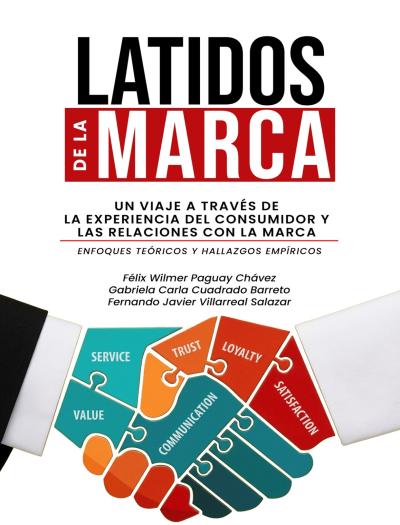
Latidos de la marca: Un viaje a través de la experiencia del consumidor y las relaciones con la marca es una obra, que abre una ventana hacia el mundo dinámico de las relaciones entre las personas y las marcas que habitan en el entorno cotidiano, desentrañan los misterios de la conexión humana con las entidades intangibles que dan forma a las decisiones de compra, percepciones y, en última instancia, a la vida de las personas.
En el primer capítulo, se exponen los orígenes de la teoría de las relaciones consumidor-marca, visto desde su evolución y desde sus humildes comienzos hasta su estado actual como un campo de estudio vibrante en el mundo de las marcas.
El viaje continúa con la humanización de las marcas en el segundo capítulo, donde se desentraña el poder del antropomorfismo y los rasgos de personalidad como una construcción de conexiones emocionales entre consumidores y marcas.
Pero no todo es luz y alegría en el mundo de las marcas. En el tercer capítulo, ingresamos en el oscuro y complejo territorio de las emociones negativas y, cómo estas se traducen detrás de las relaciones consumidor-marca, que afectan las interacciones con las marcas de manera profunda y duradera.
El significado de la relación cobra vida en el cuarto capítulo, las historias personales de los consumidores y su relación con las marcas, se traduce en las siguientes interrogantes ¿Coinciden nuestras historias con las que las marcas nos cuentan sobre sí mismas? ¿O hay una brecha entre la narrativa de la marca y nuestra experiencia real?
En el quinto capítulo, se pone en marcha el proceso de establecer relaciones, desglosando los pasos que los consumidores y las marcas dan para conectarse entre sí de manera significativa. Y finalmente, como poscapítulo, se muestra una jerga cotidiana “la yapa”: viaje adicional que a través de los latidos de la marca, se sintetizan experiencias y descubrimientos en un enfoque teórico y hallazgos empíricos que iluminarán aún más el camino hacia una comprensión más profunda de las relaciones consumidor-marca.
Amén de lo dicho, es una obra que merece compartir vuestro tiempo, vuestra sabiduría y vuestra vocación al internarse y disfrutar de este viaje tanto como yo lo he disfrutado, sobre todo, para descubrir la magia que reside en el corazón de las marcas que nos rodean.
¡Bienvenidos a Latidos de la marca!
Aagerup, U., Andersson, S., & Awuah, G. B. (2022). Building a warm and competent B2B brand personality. European Journal of Marketing, 56(13), 167-193. https://doi.org/10.1108/EJM-06-2019-0528
Aaker, J. L. (1997). Dimensions of Brand Personality. Journal of Marketing Research, 34(3), 347–356. https://doi.org/10.1177/002224379703400304
Aaker, J. L., Benet-Martínez, V., & Garolera, J. (2001). Consumption symbols as carriers of culture: A study of Japanese and Spanish brand personality constructs. Journal of Personality and Social Psychology, 81(3), 492–508. https://doi.org/10.1037/0022-3514.81.3.492
Aaker, J. L., Vohs, K. D., & Mogilner, C. (2010). Nonprofits are seen as warm and forprofits as competent: Firm stereotypes matter. Journal of Consumer Research, 37(2), 224-237. https://doi.org/10.1086/651566
Abril, L. (15 de junio de 2023). Comercio electrónico en Ecuador crecerá un 25% en 2023. El Comercio. Recuperado de: https://www.elcomercio.com/actualidad/negocios/comercio-electronico-ecuador-crecera-ecuador-negocios.html
Albert, N., & Thomson, M. (2018). A Synthesis of the Consumer-Brand Relationship Domain: Using Text Mining to Track Research Streams, Describe Their Emotional Associations, and Identify Future Research Priorities. Journal of the Association for Consumer Research, 3(2), 130-146. https://doi.org/10.1086/696825
Allen, C. T., Fournier, S., & Miller, F. (2008). Brands and their meaning makers. In Haugtvedt, Herr & Kardes (Eds.), Handbook of consumer psychology (pp. 781–822). Taylor & Francis Group/Lawrence Erlbaum Associates.
Alvarez, C., Brick, D. J., & Fournier, S. (2021). Doing Relationship Work: A Theory of Change in Consumer–Brand Relationships. Journal of Consumer Research, 48(4), 610-632. https://doi.org/10.1093/jcr/ucab022
Alvarez, C., David, M. E., & George, M. (2023). Types of Consumer-Brand Relationships: A systematic review and future research agenda. Journal of Business Research, 160, 113753. https://doi.org/10.1016/j.jbusres.2023.113753
Alvarez, C., & Fournier, S. (2016). Consumers’ relationships with brands. Current Opinion in Psychology, 10, 129-135. https://doi.org/10.1016/j.copsyc.2015.12.017
Avery, J., Fournier, S., & Wittenbraker, J. (2014). Unlock the mysteries of your customer relationships. Harvard Business Review, 92(7), 72-81
Aziz, R., & Rahman, Z. (2022). Brand hate: a literature review and future research agenda. European Journal of Marketing, 56(7), 2014-2051. https://doi.org/10.1108/EJM-03-2021-0189
Barney, C., Hancock, T., Jones, C. L. E., Kazandjian, B., & Collier, J. E. (2022). Ideally human-ish: How anthropomorphized do you have to be in shopper-facing retail technology?. Journal of Retailing, 98(4), 685-705. https://doi.org/10.1016/j.jretai.2022.04.001
Batra, R. (2019). Creating brand meaning: a review and research agenda. Journal of Consumer Psychology, 29(3), 535-546. https://doi.org/10.1002/jcpy.1122
Bock, D. E., & Thomas, V. L. (2023). Too exciting to care? When expressing gratitude is a detriment to the brand. Journal of Advertising, 52(2), 211-228. https://doi.org/10.1080/00913367.2021.1990812
Cañete, J., Chaperon, G., Fuentes, R., Ho, J. H., Kang, H., & Pérez, J. (2020). Spanish pre-trained bert model and evaluation data. Pml4dc at iclr, 2020(2020), 1-10.
Cárdenas, G., Bastidas, J., Mora, A., & Fuentes, J. (2023). Desempeño de las microempresas de Carchi durante el Covid-19. Polo del Conocimiento, 8(1), 1796-1817. http://dx.doi.org/10.23857/pc.v8i1.5166
Chaudhuri, A & Holbrook, M. (2001). The chain of effects from brand trust and brand affect to brand performance: the role of brand loyalty. Journal of Marketing, 65(2), 81-93. https://doi.org/10.1509/jmkg.65.2.81.18255
Chen, K. J., & Lin, J. S. (2021). Revisiting the effects of anthropomorphism on brand relationship outcomes: the moderating role of psychological disposition. European Journal of Marketing, 55(8), 2174-2200. https://doi.org/10.1108/EJM-07-2018-0471
Chen, R. P., Wan, E. W., & Levy, E. (2017). The effect of social exclusion on consumer preference for anthropomorphized brands. Journal of Consumer Psychology, 27(1), 23-34. https://doi.org/10.1016/j.jcps.2016.05.004
Christodoulides, G., Gerrath, M. H., & Siamagka, N. T. (2021). Don't be rude! The effect of content moderation on consumer‐brand forgiveness. Psychology & Marketing, 38(10), 1686-1699. https://doi.org/10.1002/mar.21458
Coulter, R. A., & Ligas, M. (2000). The long good‐bye: The dissolution of customer‐service provider relationships. Psychology & Marketing, 17(8), 669-695. https://doi.org/10.1002/1520-6793(200008)17:8<669::AID-MAR2>3.0.CO;2-T
Coulter, R. A., Price, L. L., & Feick, L. (2003). Rethinking the Origins of Involvement and Brand Commitment: Insights from Postsocialist Central Europe. Journal of Consumer Research, 30(2), 151 –169. https://doi.org/10.1086/376809
Cristancho-Triana, G. J., Cardozo-Morales, Y. C., & Camacho-Gómez, A. S. (2022). Tipos de centennials en la red social TikTok y su percepción hacia la publicidad. Revista CEA, 8(17), e1933. https://doi.org/10.22430/24223182.1933
Crolic, C., Thomaz, F., Hadi, R., & Stephen, A. T. (2022). Blame the Bot: Anthropomorphism and Anger in Customer–Chatbot Interactions. Journal of Marketing, 86(1), 132–148. https://doi.org/10.1177/00222429211045687
Dalman, M.D., Agarwal, M.K., & Min, J. (2021). Impact of brand anthropomorphism on ethical judgment: the roles of failure type and loneliness. European Journal of Marketing, 55(11), 2917-2944. https://doi.org/10.1108/EJM-10-2019-0788
Das, M., & Ramalingam, M. (2022). What drives product involvement and satisfaction with OFDs amid COVID-19?. Journal of Retailing and Consumer Services, 68, 103063. https://doi.org/10.1016/j.jretconser.2022.103063
Denegri, M., Cabezas, D., Novoa, M., Peralta, J., & Estrada, C. (2013). Personalidad de marca en carreras de psicología de zonas territoriales extremas: Arica y Punta Arenas. MAGALLANIA, 41(2), 85-100. https://dx.doi.org/10.4067/S0718-22442013000200003
Deska, J. C., Hingston, S. T., DelVecchio, D., Stenstrom, E. P., Walker, R. J., & Hugenberg, K. (2022). The face of the brand: Spokesperson facial width‐to‐height ratio predicts brand personality judgments. Psychology & Marketing, 39(8), 1487-1503. https://doi.org/10.1002/mar.21666
Ding, Y., & Xu, S. (2023). Detrimental impact of contagious disease cues on consumer preference for anthropomorphic products. Marketing Letters, 34(1), 139-153. https://doi.org/10.1007/s11002-022-09614-x
Diniz, F., & Suarez, M. C. (2018). Cultural Meanings and Consumers' Discourses about Their Brand Abandonment. BAR - Brazilian Administration Review, 15(1), e170061. https://doi.org/10.1590/1807-7692bar2018170061
DiStefano, C., McDaniel, H. L., Zhang, L., Shi, D., & Jiang, Z. (2019). Fitting Large Factor Analysis Models With Ordinal Data. Educational and Psychological Measurement, 79(3), 417–436. https://doi.org/10.1177/0013164418818242
Donvito, R., Aiello, G., Grazzini, L., Godey, B., Pederzoli, D., Wiedmann, K. P., et al. (2020). Does personality congruence explain luxury brand attachment? The results of an international research study. Journal of Business Research, 120, 462-472. https://doi.org/10.1016/j.jbusres.2020.06.047
Duesterhaus, A., & Duesterhaus, M. (2014). Attributes of successful university brands in the USA. Journal of Brand Strategy, 3(2), 169-183.
Eisend, M., & Stokburger-Sauer, N. E. (2013). Brand personality: A meta-analytic review of antecedents and consequences. Marketing Letters, 24, 205-216. https://doi.org/10.1007/s11002-013-9232-7
Ekman, P. (1992). An argument for basic emotions. Cognition and Emotion, 6(3-4), 169-200, https://doi.org/10.1080/02699939208411068
Ekos. (16 de noviembre de 2021). Tipti, un negocio con tecnología de punta que busca facilitar la vida de las personas. Ekos/Business culture. Recuperado de: https://ekosnegocios.com/articulo/tipti-un-negocio-con-tecnologia-de-punta-que-busca-facilitar-la-vida-de-las-personas
El Comercio. (03 de mayo de 2023). Quejas por la app de Banco Pichincha persisten por segundo día. El Comercio. Recuperado de: https://www.elcomercio.com/actualidad/negocios/quejas-app-banco-pichincha-persisten-por-segundo-dia.html
El Universo. (04 de abril de 2023). Usuarios de Banco Pichincha vuelven de a poco a tener servicio sin una explicación a este reiterado inconveniente. El Universo. Recuperado de: https://www.eluniverso.com/noticias/economia/usuarios-de-banco-pichincha-vuelven-de-a-poco-a-tener-servicio-sin-una-explicacion-a-este-reiterado-inconveniente-nota/
El Universo. (28 de abril de 2023). Tipti Tech Academy convoca a mujeres de Ecuador para 150 becas en programación, desarrollo de software y análisis de datos. El Universo. Recuperado de: https://www.eluniverso.com/noticias/economia/tipti-tech-academy-convoca-a-mujeres-de-ecuador-para-150-becas-en-programacion-desarrollo-de-software-y-analisis-de-datos-nota/
Escalas, J. E., & Bettman, J. R. (2003). You are what they eat: The influence of reference groups on consumers’ connections to brands. Journal of Consumer Psychology, 13(3), 339 –348. https://doi.org/10.1207/S15327663JCP1303_14
Escalas, J. E., & Bettman, J. R. (2005). Self-construal, reference groups, and brand meaning. Journal of Consumer Research, 32(3), 378 –389. https://doi.org/10.1086/497549
Expectativa. (23 de abril de 2021). TIPTI continuará con la entrega a domicilio de compras de supermercado. Expectativa. Recuperado de: https://www.expectativa.ec/tipti-continuara-con-la-entrega-a-domicilio-de-compras-de-supermercado/#:~:text=Los%20supermercados%20se%20encuentran%20abastecidos,que%20demanda%20la%20nueva%20normalidad.
Expreso. (13 de noviembre de 2017). Tipti, una app ideada para regalarte tiempo. Expreso. Recuperado de: https://www.expreso.ec/actualidad/tipti-app-ideada-regalarte-71014.html
Feiereisen, S., Rasolofoarison, D., Russell, C. A., & Schau, H. J. (2021). One brand, many trajectories: Narrative navigation in transmedia. Journal of Consumer Research, 48(4), 651-681. https://doi.org/10.1093/jcr/ucaa046
Fernandes, T & Inverneiro, I. (2021). From fandom to fad: are millennials really engaged with and loyal to their loved brands on social media?. Journal of Product & Brand Management, 30(2), 320-334. https://doi.org/10.1108/JPBM-02-2019-2262
Folse, J. A., Burton, S., & Netemeyer, R. G. (2013). Defending Brands: Effects of Alignment of Spokescharacter Personality Traits and Corporate Transgressions on Brand Trust and Attitudes. Journal of Advertising, 42(4), 331-342. https://doi.org/10.1080/00913367.2013.795124
Fournier, S. (1998). Consumers and their brands: Developing relationship theory in consumer research. Journal of Consumer Research, 24(4), 343– 373. https://doi.org/10.1086/209515
Fournier, S. (2009). Lessons learned about consumers’ relationships with their brands. In McInnis, Park & Priester (Eds.) Handbook of brand relationships (pp. 27-45). M E Sharpe. https://doi.org/10.4324/9781315703886
Fournier, S., & Alvarez, C. (2012). Brands as relationship partners: Warmth, competence, and in-between. Journal of consumer psychology, 22(2), 177-185. https://doi.org/10.1016/j.jcps.2011.10.003
Fournier, S., & Alvarez, C. (2013). Relating badly to brands. Journal of Consumer Psychology, 23(2), 253-264. https://doi.org/10.1016/j.jcps.2013.01.004
Fournier, S., & Alvarez, C. (2019). How brands acquire cultural meaning. Journal of Consumer Psychology, 29(3), 519-534. https://doi.org/10.1002/jcpy.1119
Garbas, J., Schubach, S., Mende, M., Scott, M. L., & Schumann, J. H. (2023). You want to sell this to me twice!? How perceptions of betrayal may undermine internal product upgrades. Journal of the Academy of Marketing Science, 51(2), 286-309. https://doi.org/10.1007/s11747-022-00881-8
Gerrath, M. H., Brakus, J. J., Siamagka, N. T., & Christodoulides, G. (2023). Avoiding the brand for me, us, or them? Consumer reactions to negative brand events. Journal of Business Research, 156, 113533. https://doi.org/10.1016/j.jbusres.2022.113533
Ghorbanzadeh, D. (2023). The role of brand love and brand jealousy in the formation of brand addiction. Current Psychology. https://doi.org/10.1007/s12144-023-04508-1
Giraldo, W., & Otero, M. (2023). Efectos de la diversidad estudiantil en la marca universitaria. Análisis comparativo entre dos universidades de Colombia y México. Criterio Libre, 20(36), e299805. https://doi.org/10.18041/1900-0642/criteriolibre.2022v20n36.9805
Golossenko, A., Pillai, K. G., & Aroean, L. (2020). Seeing brands as humans: Development and validation of a brand anthropomorphism scale. International Journal of Research in Marketing, 37(4), 737-755. https://doi.org/10.1016/j.ijresmar.2020.02.007
He, J, & Zhang, F. (2022). Dynamic brand positioning: a firm-customer synergistic strategy of brand meaning cocreation in a hyperconnected world. European Journal of Marketing, 56(10), 2774-2803. https://doi.org/10.1108/EJM-10-2021-0813
Hegner, S.M., Fetscherin, M., & van Delzen, M. (2017). Determinants and outcomes of brand hate. Journal of Product & Brand Management, 26(1), 13-25. https://doi.org/10.1108/JPBM-01-2016-1070
Hinde, R. A. (1995). A suggested structure for a science of relationships. Personal Relationships, 2(1), 1-15. https://doi.org/10.1111/j.1475-6811.1995.tb00074.x
Hinde, R. A., & Stevenson-Hinde, J. (1976). Towards understanding relationships: dynamic stability. In Bateson & Hinde (Eds.) Growing points in ethology (pp. 451-479). Cambridge University Press
Holt, D. (2016). Branding in the age of social media. Harvard Business Review, 94(3), 40-50.
Holt, D. (2017). Consumer Culture Strategy. In Sherry & Fischer (Eds.) Contemporary Consumer Culture Theory, pp. 215-224. Routledge, New York. https://doi.org/10.4324/9781315563947
Hu, M., Chen, J., Alden, D. L., & Chen, Q. (2023). The Coalescence Effect: How a Combination of Foreign and Local Appeals Enhances Customer Engagement Through Perceived Brand Globalness. Journal of International Marketing, 31(1), 49–68. https://doi.org/10.1177/1069031X221134495
Huaman‐Ramirez, R., Lunardo, R., & Vasquez‐Parraga, A. (2022). How brand self‐disclosure helps brands create intimacy with customers: The role of information valence and anthropomorphism. Psychology & Marketing, 39(2), 460-477. https://doi.org/10.1002/mar.21609
INEC. (2021). Directorio de Empresas y Establecimientos 2020: Principales resultados. Instituto Nacional de Estadísticas y Censos. Recuperado de: https://www.ecuadorencifras.gob.ec/documentos/web-inec/Estadisticas_Economicas/DirectorioEmpresas/Directorio_Empresas_2020/Principales_Resultados_DIEE_2020.pdf
Janssen, C., Swaen, V., & Du, S. (2022). Is a specific claim always better? The double-edged effects of claim specificity in green advertising. Journal of Business Research, 151, 435-447. https://doi.org/10.1016/j.jbusres.2022.07.005
Japutra, A., & Molinillo, S. (2019). Responsible and active brand personality: On the relationships with brand experience and key relationship constructs. Journal of Business Research, 99, 464-471. https://doi.org/10.1016/j.jbusres.2017.08.027
Jiménez-Barreto, J., Loureiro, S. M. C., Rubio, N., & Romero, J. (2022). Service brand coolness in the construction of brand loyalty: A self-presentation theory approach. Journal of Retailing and Consumer Services, 65, 102876. https://doi.org/10.1016/j.jretconser.2021.102876
Jones, T., Ranaweera, C., Murray, J., & Bansal, H. (2018). A prototyping analysis of relationship marketing constructs: what constructs to use when. Journal of Marketing Management, 34(9-10), 865-901. https://doi.org/10.1080/0267257X.2018.1520281
Keller, K. L. (2016). Unlocking the power of integrated marketing communications: How integrated is your IMC program?. Journal of Advertising, 45(3), 286-301. https://doi.org/10.1080/00913367.2016.1204967
Khamitov, M., Wang, X., & Thomson, M. (2019). How well do consumer-brand relationships drive customer brand loyalty? Generalizations from a meta-analysis of brand relationship elasticities. Journal of Consumer Research, 46(3), 435-459. https://doi.org/10.1093/jcr/ucz006
Kim, H. C., & Kramer, T. (2015). Do materialists prefer the “brand-as-servant”? The interactive effect of anthropomorphized brand roles and materialism on consumer responses. Journal of Consumer Research, 42(2), 284-299. https://doi.org/10.1093/jcr/ucv015
Kim, J., & Swaminathan, S. (2021). Time to say goodbye: The impact of anthropomorphism on selling prices of used products. Journal of Business Research, 126, 78-87. https://doi.org/10.1016/j.jbusres.2020.12.046
Kim, S., Murray, K. B., & Moore, S. G. (2023). Some like it warm: How warm brands mitigate the negative effects of social exclusion. Psychology & Marketing, 40(4), 777-790. https://doi.org/10.1002/mar.21786
Kucuk, S. U. (2019). Consumer brand hate: Steam rolling whatever I see. Psychology & Marketing, 36(5), 431-443. https://doi.org/10.1002/mar.21175
Kwak, H., Puzakova, M., & Rocereto, J. F. (2015). Better Not Smile at the Price: The Differential Role of Brand Anthropomorphization on Perceived Price Fairness. Journal of Marketing, 79(4), 56–76. https://doi.org/10.1509/jm.13.0410
Kwak, H., Puzakova, M., & Rocereto, J. F. (2017). When brand anthropomorphism alters perceptions of justice: The moderating role of self-construal. International Journal of Research in Marketing, 34(4), 851-871. https://doi.org/10.1016/j.ijresmar.2017.04.002
Kwan, C. M., Dai, X., & Wyer Jr, R. S. (2017). Contextual influences on message persuasion: The effect of empty space. Journal of Consumer Research, 44(2), 448-464. https://doi.org/10.1093/jcr/ucx051
Lee, S. A., & Oh, H. (2021). Anthropomorphism and its implications for advertising hotel brands. Journal of Business Research, 129, 455-464. https://doi.org/10.1016/j.jbusres.2019.09.053
Leung, E., Lenoir, A. S. I., Puntoni, S., & van Osselaer, S. M. (2022). Consumer preference for formal address and informal address from warm brands and competent brands. Journal of Consumer Psychology. https://doi.org/10.1002/jcpy.1322
Lin, K., Du, W., Yang, S., Liu, C., & Na, S. (2023). The Effects of Social Media Communication and e-WOM on Brand Equity: The Moderating Roles of Product Involvement. Sustainability, 15(8), 6424. https://doi.org/10.3390/su15086424
Littel, S. & Orth, U.R. (2013). "Effects of package visuals and haptics on brand evaluations", European Journal of Marketing, 47(1/2), 198-217. https://doi.org/10.1108/03090561311285510
Loroz, P. S., & Braig, B. M. (2015). Consumer attachments to human brands: The “Oprah effect”. Psychology & Marketing, 32(7), 751-763. https://doi.org/10.1002/mar.20815
Lovett, M., Peres, R., & Shachar, R. (2014). A data set of brands and their characteristics. Marketing Science, 33(4), 609-617. https://doi.org/10.1287/mksc.2014.0861
Lunardo, R., Oliver, M. A., & Shepherd, S. (2023). How believing in brand conspiracies shapes relationships with brands. Journal of Business Research, 159, 113729. https://doi.org/10.1016/j.jbusres
MacInnis, D. J., Torelli, C. J., & Park, C. W. (2019). Creating cultural meaning in products and brands: A psychological perspective. Journal of Consumer Psychology, 29(3), 555-562. https://doi.org/10.1002/jcpy.1118
MacInnis, D., & Folkes, V. (2017). Humanizing brands: When brands seem to be like me, part of me, and in a relationship with me. Journal of Consumer Psychology, 27(3), 355-374. https://doi.org/10.1016/j.jcps.2016.12.003
Malika, M., & Maheswaran, D. (2023). Busy or poor: How time or money scarcity cues differentially impact purchase decisions regarding service firms. Journal of the Academy of Marketing Science. https://doi.org/10.1007/s11747-022-00922-2
Malone C., & Fiske, S. T. (2013). The human brand: How we relate to people, products and companies. New York, NY: Jossey-Bass.
Mrad, M., Majdalani, J., Cui, C. C., & El Khansa, Z. (2020). Brand addiction in the contexts of luxury and fast-fashion brands. Journal of Retailing and Consumer Services, 55, 102089. https://doi.org/10.1016/j.jretconser.2020.102089
Muñiz, A., & Schau, H. (2005). Religiosity in the Abandoned Apple Newton Brand Community. Journal of Consumer Research, 31(4), 737–747, https://doi.org/10.1086/426607
Núñez, Y., & Rodríguez, C. (2015). Gestión de recursos intangibles en Instituciones de Educación Superior. Revista De Administração De Empresas, 55(1), 65–77. https://doi.org/10.1590/S0034-759020150107
Olovacha, N, & Lovato, F. (2023). Análisis Du Pont (árbol de rentabilidad) del sistema de bancos privados. Período: septiembre 2021–septiembre 2022. Superintendencia de Bancos. Recuperado de: https://www.superbancos.gob.ec/estadisticas/portalestudios/estudios-y-analisis/
Oñate, S. (19 de octubre de 2022). Ecuador levanta restricciones por el covid-19. El Comercio. Recuperado de: https://www.elcomercio.com/actualidad/ecuador/ecuador-levanta-restricciones-covid19.html
Osuna-Ramírez, S.A., Veloutsou, C. & Morgan-Thomas, A. (2019). I hate what you love: brand polarization and negativity towards brands as an opportunity for brand management. Journal of Product & Brand Management, 28(5), 614-632. https://doi.org/10.1108/JPBM-03-2018-1811
Ozuem, W., Willis, M., Howell, K., Helal, G., Ranfagni, S., & Lancaster, G. (2021). Effects of online brand communities on millennials' brand loyalty in the fashion industry. Psychology & Marketing, 38(5), 774-793. https://doi.org/10.1002/mar.21466
Park, C. W., Eisingerich, A. B., & Park, J. W. (2013). Attachment–aversion (AA) model of customer–brand relationships. Journal of Consumer Psychology, 23(2), 229-248. https://doi.org/10.1016/j.jcps.2013.01.002
Parmentier, M. A., & Fischer, E. (2015). Things fall apart: The dynamics of brand audience dissipation. Journal of Consumer Research, 41(5), 1228-1251. https://doi.org/10.1086/678907
Pavone, G., Meyer-Waarden, L., & Munzel, A. (2023). Rage Against the Machine: Experimental Insights into Customers’ Negative Emotional Responses, Attributions of Responsibility, and Coping Strategies in Artificial Intelligence–Based Service Failures. Journal of Interactive Marketing, 58(1), 52–71. https://doi.org/10.1177/10949968221134492
Pérez, J. M., Giudici, J. C., & Luque, F. (2021). pysentimiento: A python toolkit for sentiment analysis and socialnlp tasks. ArXiv, abs/2106.09462. https://doi.org/10.48550/arXiv.2106.09462
Pogacar, R., Angle, J., Lowrey, T. M., Shrum, L. J., & Kardes, F. R. (2021). Is Nestlé a Lady? The Feminine Brand Name Advantage. Journal of Marketing, 85(6), 101–117. https://doi.org/10.1177/0022242921993060
Puzakova, M., & Kwak, H. (2017). Should Anthropomorphized Brands Engage Customers? The Impact of Social Crowding on Brand Preferences. Journal of Marketing, 81(6), 99–115. https://doi.org/10.1509/jm.16.0211
Ran, Y., & Wan, E. W. (2023). Enjoyment or autonomy? The interactive effect of brand ritual and brand personality on consumer purchase. Psychology & Marketing, 40(1), 89-106. https://doi.org/10.1002/mar.21731
Rauschnabel, P. A., Krey, N., Babin, B. J., & Ivens, B. S. (2016). Brand management in higher education: the university brand personality scale. Journal of Business Research, 69(8), 3077-3086. https://doi.org/10.1016/j.jbusres.2016.01.023
Roberts, M. E., Stewart, B. M., & Tingley, D. (2019). stm: An R Package for Structural Topic Models. Journal of Statistical Software, 91(2), 1–40. https://doi.org/10.18637/jss.v091.i02
Rodrigues, P. & Pinto, A. (2021). Negative emotions toward a financial brand: the opposite impact on brand love. European Business Review, 33(2), 272-294. https://doi.org/10.1108/EBR-12-2018-0221
Romani, S., Grappi, S. & Dalli, D. (2012). Emotions that drive consumers away from brands: measuring negative emotions toward brands and their behavioral effects. International Journal of Research in Marketing, 29(1), 55-67. https://doi.org/10.1016/j.ijresmar.2011.07.001
Roy, R., & Naidoo, V. (2021). Enhancing chatbot effectiveness: The role of anthropomorphic conversational styles and time orientation. Journal of Business Research, 126, 23-34. https://doi.org/10.1016/j.jbusres.2020.12.051
Saunders, M., Lewis, P. and Thornhill, A. (2016). Research methods for business students. 7th ed. Essex: Pearson Education Limited.
Schott, C., Cupolillo, M., & Suarez, M. (2014). Empirical Evidences of Brand Cultural Resonance: How Brazilians Demonstrators Appropriated a Fiat’s Campaign. ACR North American Advances. Recuperado de: https://www.acrwebsite.org/volumes/v42/acr_v42_17653.pdf
Schroll, R. (2022). “Ouch!” When and why food anthropomorphism negatively affects consumption. Journal of Consumer Psychology. https://doi.org/10.1002/jcpy.1316
Segura-Mariño, A., Fernández-Sande, M., & Paniagua-Rojano, F. (2021). Percepción de estudiantes sobre la comunicación institucional universitaria. Cuadernos.info, (50), 299-322. https://dx.doi.org/10.7764/cdi.50.27617
Serrano, D. (12 de octubre de 2021a). Cinco canales afectados en Banco Pichincha reportan la Superintendencia de Bancos. El Comercio. Recuperado de: https://www.elcomercio.com/actualidad/negocios/cinco-canales-afectados-banco-pichincha-superintendencia-bancos.html
Serrano, D. (12 de octubre de 2021b). Servicios digitales del Banco Pichincha siguen con problemas, según usuarios. El Comercio. Recuperado de: https://www.elcomercio.com/actualidad/negocios/problemas-servicios-digitales-banco-pichincha.html
Serrano, D. (13 de octubre de 2021c). Problemas colaterales por fallas en Banco Pichincha. El Comercio. Recuperado de: https://www.elcomercio.com/actualidad/negocios/problemas-colaterales-fallas-banco-pichincha.html
Serrano, D. (13 de octubre de 2021d). Defensoría del Pueblo se pronuncia sobre situación en BP. El Comercio. Recuperado de: https://www.elcomercio.com/actualidad/negocios/defensoria-pueblo-reparacion-banco-pichincha.html
Sharma, M., & Rahman, Z. (2022). Anthropomorphic brand management: An integrated review and research agenda. Journal of Business Research, 149, 463-475. https://doi.org/10.1016/j.jbusres.2022.05.039
Soria, A., & Almeida, R. (2022). Factores que influyen en el capital de marca universitario en las instituciones de educación superior. Revista Perspectivas, (50), 9-30.
Srull, T.K. & Wyer, R.S. (1989). Person memory and judgment. Psychological Review, 96(1), 58–83. https://doi.org/10.1037/0033-295X.96.1.58
Sundar, A., & Noseworthy, T. J. (2016). Too exciting to fail, too sincere to succeed: The effects of brand personality on sensory disconfirmation. Journal of Consumer Research, 43(1), 44-67. https://doi.org/10.1093/jcr/ucw003
Sung, Y., & Kim, J. (2010). Effects of brand personality on brand trust and brand affect. Psychology & Marketing, 27(7), 639-661. https://doi.org/10.1002/mar.20349
Superintendencia de Bancos. (2023). Estadísticas de Servicios Financieros Reportados año 2022. Archivo de Excel. Recuperado de: https://www.superbancos.gob.ec/estadisticas/portalestudios/servicios-financieros/#01ONK3WL6477HFCFZ6VZAK7MAVEVU5KAFG
Swaminathan, V., Sorescu, A., Steenkamp, J.-B. E. M., O’Guinn, T. C. G., & Schmitt, B. (2020). Branding in a Hyperconnected World: Refocusing Theories and Rethinking Boundaries. Journal of Marketing, 84(2), 24–46. https://doi.org/10.1177/0022242919899905
Sweeney, J. C., & Brandon, C. (2006). Brand personality: Exploring the potential to move from factor analytical to circumplex models. Psychology & Marketing, 23(8), 639-663. https://doi.org/10.1002/mar.20122
Tan, S. Z., Bandyopadhyay, A., & Septianto, F. (2023). Relationship (breakup) reminders drive online advertising effectiveness. Psychology & Marketing. https://doi.org/10.1002/mar.21796
Tan, T. M., Balaji, M. S., Oikarinen, E. L., Alatalo, S., & Salo, J. (2021). Recover from a service failure: The differential effects of brand betrayal and brand disappointment on an exclusive brand offering. Journal of Business Research, 123, 126-139. https://doi.org/10.1016/j.jbusres.2020.09.056
Tapia, E. (30 de marzo de 2020). Demanda de servicio a domicilio por ‘apps’ se disparó y pedidos demoran. El Comercio. Recuperado de: https://www.elcomercio.com/actualidad/negocios/apps-delivery-demanda-demora-pedidos.html
Thompson, C. J., Rindfleisch, A., & Arsel, Z. (2006). Emotional Branding and the Strategic Value of the Doppelgänger Brand Image. Journal of Marketing, 70(1), 50–64. https://doi.org/10.1509/jmkg.70.1.050.qxd
Tong, Z., Feng, J. & Liu, F. (2022). Understanding damage to and reparation of brand trust: a closer look at image congruity in the context of negative publicity. Journal of Product & Brand Management. https://doi.org/10.1108/JPBM-07-2021-3550
Torelli, C.J., Oh, H., & Stoner, J.L. (2021). Cultural equity: knowledge and outcomes aspects. International Marketing Review, 38(1), 99-123. https://doi.org/10.1108/IMR-12-2018-0366
van Esch, P., Cui, Y., Arli, D., & Hutchins, J. (2022). Anthropomorphizing religious advertising: The moderating role of political ideology. Psychology & Marketing, 39(12), 2284-2301. https://doi.org/10.1002/mar.21739
van Rompay, T. J., Fransen, M. L., & Borgelink, B. G. (2014). Light as a feather: Effects of packaging imagery on sensory product impressions and brand evaluation. Marketing Letters, 25, 397-407. https://doi.org/10.1007/s11002-013-9260-3
Vizcaíno, F. V. (2018). A Meta-Analytic Investigation of the Relationship between Anthropomorphism and Consumers’ Responses: Effects, Mechanism, and Boundary Conditions [Doctoral dissertation, The University of Texas at Arlington]. The University of Texas at Arlington Research Commons. http://hdl.handle.net/10106/28658
Werle, C. O. C., Pruski Yamim, A., Trendel, O., Roche, K., & Nadaud, P. (2022). When Detailed Information Works Better: Comparison of Three- and Five-Color/Letter Front-of-Package Nutrition Labels. Journal of Public Policy & Marketing, 41(2), 177–195. https://doi.org/10.1177/07439156211061289
Whang, C., & Im, H. (2021). " I Like Your Suggestion!" the role of humanlikeness and parasocial relationship on the website versus voice shopper's perception of recommendations. Psychology & Marketing, 38(4), 581-595. https://doi.org/10.1002/mar.21437
Xu, H., Bolton, L. E., & Winterich, K. P. (2021). How do consumers react to company moral transgressions? The role of power distance belief and empathy for victims. Journal of Consumer Research, 48(1), 77-101. https://doi.org/10.1093/jcr/ucaa067
Yin, R. (2013). Case Study Research: Design and Methods. Thousand Oaks, CA: SAGE Publications.
Zhang, Q., Peng, Z., Guo, X., & Vogel, D. (2023). Product involvement and routine use of a niche product from a well-known company: The moderating effect of gender. Information & Management, 60(2), 103758. https://doi.org/10.1016/j.im.2023.103758
Zhang, Z., Zhou, Q., & Yan, D. (2023). It's not mine: Anthropomorphism attenuates the effect of psychological ownership on product‐to‐self judgment. Psychology & Marketing, 40(6), 1103-1114. https://doi.org/10.1002/mar.21800

Esta obra está bajo una licencia internacional Creative Commons Atribución-NoComercial-CompartirIgual 4.0.
No es necesario que cumpla con la licencia para los elementos del material que sean de dominio público o cuando su uso esté permitido por una excepción o limitación aplicable .
No se ofrecen garantías. La licencia podría no otorgarle todos los permisos necesarios para el uso previsto. Por ejemplo, otros derechos, como los de publicidad, privacidad o morales, podrían limitar el uso del material.