https://orcid.org/0009-0002-8494-5345






La educación inclusiva representa uno de los mayores desafíos y, al mismo tiempo, una de las más profundas oportunidades de transformación de los sistemas educativos contemporáneos. En un mundo caracterizado por la diversidad cultural, social y tecnológica, repensar la educación desde la inclusión no es una opción, sino una necesidad impostergable.
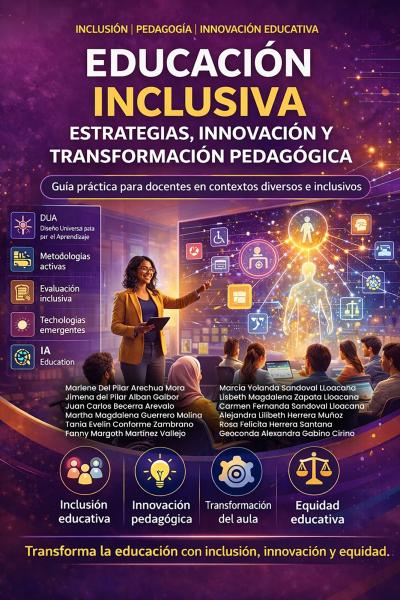
El presente libro constituye una valiosa contribución al campo de la innovación educativa, al ofrecer una mirada integral que articula fundamentos teóricos, enfoques pedagógicos y estrategias prácticas orientadas a la construcción de entornos de aprendizaje inclusivos. A lo largo de sus capítulos, se aborda la evolución del concepto de inclusión, el papel de las metodologías activas, el Diseño Universal para el Aprendizaje, la integración de tecnologías emergentes y la transformación del rol docente.
Uno de los principales aportes de esta obra radica en su enfoque sistémico, que permite comprender la educación inclusiva como un proceso complejo que involucra múltiples dimensiones: pedagógicas, tecnológicas, curriculares e institucionales. Esta perspectiva resulta fundamental para evitar visiones reduccionistas y promover cambios sostenibles en el tiempo.
Asimismo, el libro destaca el papel del docente como agente clave en la transformación educativa. No se trata únicamente de aplicar estrategias innovadoras, sino de asumir un compromiso ético y profesional con la equidad, la diversidad y la justicia social.
Otro aspecto relevante es la incorporación de tecnologías emergentes como herramientas para la inclusión, analizadas desde una mirada crítica que reconoce tanto sus potencialidades como sus desafíos. En este sentido, la obra invita a reflexionar sobre la necesidad de integrar la innovación tecnológica con fundamentos pedagógicos sólidos.
En definitiva, este libro no solo ofrece conocimientos, sino que propone una invitación a la acción. Está dirigido a docentes, investigadores, directivos y estudiantes de educación que buscan comprender y aplicar estrategias inclusivas en sus contextos.
La educación inclusiva no se construye únicamente desde la teoría, sino desde la práctica cotidiana, el compromiso y la reflexión constante. Este libro es, sin duda, una guía valiosa para avanzar en ese camino.
Ainscow, M. (2020). Promoting inclusion and equity in education: Lessons from international experiences. Nordic Journal of Studies in Educational Policy, 6(1), 7–16. https://doi.org/10.1080/20020317.2020.1729587
Akçayır, M., & Akçayır, G. (2019). Advantages and challenges of augmented reality. Educational Research Review, 27. https://doi.org/10.1016/j.edurev.2019.100289
Al-Azawei, A., Serenelli, F., & Lundqvist, K. (2019). Universal Design for Learning (UDL): A content analysis of peer-reviewed journals. Journal of Computer Assisted Learning, 35(3), 255–267. https://doi.org/10.1111/jcal.12330
Altes, T. K., Willemse, M., Goei, S. L., & Ehren, M. (2024). Higher education teachers’ understandings of and challenges for inclusion and inclusive learning environments: A systematic literature review. Educational Review. https://doi.org/10.1016/j.edurev.2024.100605
Artiles, A. J., Kozleski, E. B., & Waitoller, F. R. (2021). Inclusive education: Examining equity on five continents. Harvard Education Press.
Avalos, B. (2019). Teacher professional development. Teaching and Teacher Education.
Bai, S., Hew, K. F., & Huang, B. (2020). Does gamification improve student learning? Educational Technology Research and Development, 68. https://doi.org/10.1007/s11423-020-09807-w
Banks, J. A. (2019). Multicultural education. Review of Research in Education.
Bergmann, J., & Sams, A. (2020). Flip your classroom: Reach every student in every class every day. ISTE.
Bernal Parraga, A. P. . (2026). Analítica de aprendizaje e inteligencia artificial responsable para la toma de decisiones pedagógicas basadas en datos en educación básica. LUZ, 25, e1601. Recuperado a partir de https://luz.uho.edu.cu/index.php/luz/article/view/1601
Bernal ParragaA., Alvarez SantosA., & Mite CisnerosM. (2025). Formación docente: enfoques pedagógicos innovadores para el fortalecimiento de competencias profesionales en el siglo XXI. Varona, (84). Recuperado a partir de http://revistas.ucpejv.edu.cu/index.php/rVar/article/view/2981
Bernal, A., & Guarda, T. (2020). La gestión de la información es factor determinante para elaborar estrategias innovadoras en política educativa pública. Iberian Journal of Information Systems and Technologies, (E27), 35-48. https://core.ac.uk/download/pdf/487026121.pdf#page=35
Black, P., & Wiliam, D. (2019). Classroom assessment and pedagogy. Assessment in Education.
Bond, M. (2020). Facilitating student engagement through flipped learning. Educational Technology Research and Development, 68. https://doi.org/10.1007/s11423-020-09769-z
Bond, M., Bedenlier, S., Marín, V. I., & Händel, M. (2020). Emergency remote teaching in higher education. Educational Technology Research and Development, 68, 1–35. https://doi.org/10.1007/s11423-020-09829-4
Booth, T., & Ainscow, M. (2020). Index for Inclusion
Brookhart, S. M. (2020). Classroom assessment and grading that work. ASCD.
Brookhart, S. M. (2020). How to create and use rubrics for formative assessment. ASCD.
Cabero-Almenara, J., & Llorente-Cejudo, M. C. (2020). Digital inclusion in education. Education Sciences, 10(9), 1–15. https://doi.org/10.3390/educsci10090241
CAST. (2018). Universal Design for Learning Guidelines version 2.2. http://udlguidelines.cast.org
Chen, F., Lui, A. M., & Martinelli, S. M. (2020). A systematic review of flipped classroom. Medical Education, 54(7).
Coffman, S., & Draper, C. (2022). Universal design for learning in higher education: A concept analysis. Teaching and Learning in Nursing, 17(1), 36–41. https://doi.org/10.1016/j.teln.2021.07.009
Darling-Hammond, L., Flook, L., Cook-Harvey, C., Barron, B., & Osher, D. (2020). Implications for educational practice. Educational Researcher.
Day, C., & Gu, Q. (2019). Teacher resilience and professional learning. Routledge.
Deardorff, D. K. (2021). Intercultural competence in education. International Journal of Intercultural Relations.
Deterding, S., Dixon, D., Khaled, R., & Nacke, L. (2019). From game design elements to gamefulness. Proceedings of the 15th International Academic MindTrek Conference.
Dicheva, D., Dichev, C., Agre, G., & Angelova, G. (2019). Gamification in education: A systematic mapping study. Educational Technology & Society, 22(2).
Dietz, G. (2019). Interculturality in education. Comparative Education.
European Agency for Special Needs and Inclusive Education. (2020). Teacher competence framework.
Florian, L. (2019). On the necessary co-existence of special and inclusive education. International Journal of Inclusive Education. https://doi.org/10.1080/13603116.2019.1622801
Florian, L., & Beaton, M. (2019). Inclusive pedagogy in action: Getting it right for every child. International Journal of Inclusive Education, 23(5–6), 1–15. https://doi.org/10.1080/13603116.2019.1624844
Florian, L., & Spratt, J. (2019). Enacting inclusion. Cambridge Journal of Education.
Fraser, N. (2020). Social justice in the age of identity politics: Redistribution, recognition, and participation. Critical Inquiry, 47(2), 1–25. https://doi.org/10.1086/709058
Fullan, M. (2020). Leading in a culture of change. Jossey-Bass.
Gay, G. (2020). Culturally responsive teaching. Teachers College Press.
Gheyssens, E., Griful-Freixenet, J., & Struyven, K. (2023). Differentiated instruction as an approach to establish effective teaching in inclusive classrooms. En Effective Teaching Around the World (pp. 677–689). Springer. https://doi.org/10.1007/978-3-031-31678-4_30
Gillies, R. M. (2020). Cooperative learning: Review of research and practice. Australian Journal of Teacher Education, 45(3). https://doi.org/10.14221/ajte.2020v45n3.1
Graham, L. J., Berman, J., & Bellert, A. (2020). Inclusive education and curriculum adaptation. Teaching and Teacher Education, 89.
Gulikers, J. T. M., Bastiaens, T. J., & Kirschner, P. A. (2020). Authentic assessment revisited. Educational Technology Research and Development.
Hamari, J., Shernoff, D. J., Rowe, E., Coller, B., Asbell-Clarke, J., & Edwards, T. (2020). Challenging games help students learn. Computers in Human Behavior, 54.
Harris, A., & Jones, M. (2020). COVID-19 and school leadership. School Leadership & Management.
Hattie, J., & Timperley, H. (2020). The power of feedback. Review of Educational Research.
Hernández-de-Menéndez, M., Escobar Díaz, C., & Morales-Menéndez, R. (2020). Educational experiences with Generation Z. Computers in Human Behavior, 104. https://doi.org/10.1016/j.chb.2019.106222
Holmes, W., Bialik, M., & Fadel, C. (2022). Artificial intelligence in education. Center for Curriculum Redesign.
Hwang, G. J., Wang, S. Y., & Lai, C. L. (2021). Effects of integrated active learning. Computers & Education, 162. https://doi.org/10.1016/j.compedu.2020.104086
Khalil, M., & Ebner, M. (2019). Learning analytics: Principles and constraints. Computers in Human Behavior, 92.
Khosravi, H., Shum, S. B., Chen, G., Conati, C., Tsai, Y. S., Kay, J., Knight, S., Martinez-Maldonado, R., Sadiq, S., & Gašević, D. (2022). Explainable AI in education. Computers and Education: Artificial Intelligence, 3. https://doi.org/10.1016/j.caeai.2022.100074
Koivisto, J., & Hamari, J. (2019). The rise of motivational information systems. International Journal of Information Management, 45. https://doi.org/10.1016/j.ijinfomgt.2018.10.013
Kooli, C., & Chakraoui, R. (2025). AI-driven assistive technologies in inclusive education: Benefits, challenges, and policy recommendations. Smart Futures in Technology Review. https://doi.org/10.1016/j.sftr.2025.101042
Krajcik, J. S., & Shin, N. (2020). Project-based learning. Cambridge Handbook of the Learning Sciences.
Lee, H., Kim, H., & Yan, W. (2025). Promoting inclusive AI and technology in K-12 education: A review of context, instructional strategies, and learning outcomes. Computers and Education: Artificial Intelligence, 9, 100478. https://doi.org/10.1016/j.caeai.2025.100478
Leiva, J. J., & Escarbajal, A. (2020). Educación intercultural. Revista de Educación.
Lo, C. K., & Hew, K. F. (2021). Developing a flipped learning approach. Educational Technology & Society, 24(1), 44–56.
Lomellini, A., Lowenthal, P. R., Snelson, C., & Trespalacios, J. H. (2025). Accessible and inclusive online learning in higher education: A review of the literature. Journal of Computing in Higher Education, 37, 1306–1329. https://doi.org/10.1007/s12528-024-09424-2
Luckin, R., Holmes, W., Griffiths, M., & Forcier, L. (2020). Intelligence unleashed: AI in education. Pearson.
Luckin, R., Holmes, W., Griffiths, M., & Forcier, L. (2022). Artificial intelligence in education: Promise and implications. Pearson.
Makransky, G., & Petersen, G. B. (2019). Immersive virtual reality and learning. Educational Psychology Review, 31.
Mendoza, M., & Heymann, J. (2024). Implementation of inclusive education: A systematic review of studies of inclusive education interventions in low- and lower-middle-income countries. International Journal of Disability, Development and Education, 71(3), 299–316. https://doi.org/10.1080/1034912X.2022.2095359
Meyer, A., Rose, D. H., & Gordon, D. (2019). Universal Design for Learning: Theory and practice. CAST Professional Publishing.
Mitchell, D. (2020). What really works in special and inclusive education. Routledge.
Mystakidis, S. (2022). Metaverse in education. Educational Sciences, 12(7). https://doi.org/10.3390/educsci12070486
Nicol, D. (2021). Formative assessment and self-regulated learning. Studies in Higher Education.
Nieto, S. (2020). Language, culture, and teaching. Routledge.
Novak, K. (2021). UDL now!: A teacher’s guide to applying Universal Design for Learning. CAST.
Panadero, E., & Jonsson, A. (2020). A critical review of the use of rubrics. Educational Research Review, 29. https://doi.org/10.1016/j.edurev.2019.100329
Pantić, N., & Florian, L. (2019). Teacher education for inclusion. Teaching and Teacher Education.
Pozas, M., Letzel, V., & Schneider, C. (2021). Teachers and differentiated instruction. Teaching and Teacher Education, 98. https://doi.org/10.1016/j.tate.2020.103238
Prince, M. (2020). Does active learning work? A review. Journal of Engineering Education, 109(3).
Qu, X., & Crabtree, J. (2024). UDL for inclusive higher education—What makes group work effective for diverse international students in UK? International Journal of Educational Research Open, 6, 100338
Radianti, J., Majchrzak, T. A., Fromm, J., & Wohlgenannt, I. (2020). A systematic review of immersive VR. Computers & Education, 147. https://doi.org/10.1016/j.compedu.2019.103778
Rao, K., Ok, M. W., & Bryant, B. R. (2020). A review of research on UDL. Remedial and Special Education. https://doi.org/10.1177/0741932519886795
Reddy, Y. M., & Andrade, H. (2019). A review of rubric use. Assessment & Evaluation in Higher Education, 44(2).
Rose, D. H., & Dalton, B. (2020). Learning to read in the digital age. Mind, Brain, and Education, 14(1), 74–83. https://doi.org/10.1111/mbe.12219
Rose, D. H., Gravel, J. W., & Domings, Y. M. (2021). Universal Design for Learning and inclusive assessment. Educational Psychologist, 56(1), 1–13. https://doi.org/10.1080/00461520.2020.1856387
Roski, M., Kuhn, J., & Kaspar, K. (2024). Learning analytics and the Universal Design for Learning (UDL): A clustering approach. Computers & Education, 215, 105018.
Ryan, R. M., & Deci, E. L. (2020). Intrinsic and extrinsic motivation. Contemporary Educational Psychology. https://doi.org/10.1016/j.cedpsych.2020.101860
Sailer, M., & Homner, L. (2020). The gamification of learning. Educational Psychology Review, 32. https://doi.org/10.1007/s10648-019-09498-w
Schindler, L. A., Burkholder, G. J., Morad, O. A., & Marsh, C. (2020). Computer-based technology and student engagement. International Journal of Educational Technology in Higher Education, 17(1). https://doi.org/10.1186/s41239-020-00169-4
Scully, D. (2019). Assessment authenticity in higher education. Assessment & Evaluation in Higher Education, 44.
Seale, J. (2020). Improving accessible digital learning. Computers & Education.
Selwyn, N. (2021). Education and technology: Key issues and debates (2nd ed.). Bloomsbury Academic.
Siemens, G., & Baker, R. S. (2019). Learning analytics and educational data mining. British Journal of Educational Technology, 50(1). https://doi.org/10.1111/bjet.12718
Slee, R. (2019). Inclusive education isn’t dead, it just smells funny. Routledge. https://doi.org/10.4324/9780429486869
Strelan, P., Osborn, A., & Palmer, E. (2020). The flipped classroom meta-analysis. Educational Research Review, 30. https://doi.org/10.1016/j.edurev.2020.100314
Toda, A. M., Valle, P. H., & Isotani, S. (2019). The dark side of gamification. Computers in Human Behavior, 92.
Tomlinson, C. A. (2021). How to differentiate instruction in academically diverse classrooms. ASCD
Tomlinson, C. A., & Moon, T. R. (2020). Assessment and student success in a differentiated classroom. ASCD.
Torres Illescas, V., Villacrés Prieto, P., Román Cabrera, J., Bernal Párraga, A. (2024). Charting the Path of Reading Development: A Study on the Importance and Effective Strategies for Reading in Early Ages Based on Technology. In: Gervasi, O., Murgante, B., Garau, C., Taniar, D., C. Rocha, A.M.A., Faginas Lago, M.N. (eds) Computational Science and Its Applications – ICCSA 2024 Workshops. ICCSA 2024. Lecture Notes in Computer Science, vol 14820. Springer, Cham. https://doi.org/10.1007/978-3-031-65285-1_2
Tsai, Y. S., Perrotta, C., & Gašević, D. (2020). Empowering learners with learning analytics. Computers & Education, 150. https://doi.org/10.1016/j.compedu.2020.103816
UNESCO. (2020). Global education monitoring report 2020: Inclusion and education: All means all. UNESCO Publishing. https://unesdoc.unesco.org/ark:/48223/pf0000373718
Van Alten, D. C. D., Phielix, C., Janssen, J., & Kester, L. (2019). Effects of flipped classroom. Educational Research Review, 28.
Van Mieghem, A., Verschueren, K., Petry, K., & Struyf, E. (2020). An analysis of research on inclusive education: A systematic search and meta review. International Journal of Inclusive Education, 24(6), 675–689. https://doi.org/10.1080/13603116.2018.1482012
Vásquez, M. L. M., Campos Ramírez, L. C., Yataco Bernaola, M. L., Yataco Torrealva, J. R., Ramos Torrealva, Z. M., Castro Cárdenas, D. M., & Segura Altamirano, S. F. (2025). Inclusive pedagogy and active learning in higher education: Cluster and dimensional insights into teaching competency integration. Social Sciences & Humanities Open, 12, 102060. https://doi.org/10.1016/j.ssaho.2025.102060
Villa, A., & Poblete, M. (2020). Competence-based learning. Journal of Education.
Waisath, W., McCormack, M., Stek, P., & Heymann, J. (2024). Dismantling barriers and advancing disability-inclusive education: An examination of national laws and policies across 193 countries. International Journal of Inclusive Education, 28(10), 2088–2103. https://doi.org/10.1080/13603116.2022.2058623
Waitoller, F. R., & Artiles, A. J. (2019). A decade of professional development research. Review of Educational Research. https://doi.org/10.3102/0034654318817476
Walsh, C. (2020). Interculturality and decoloniality. International Journal of Educational Development.
Wiliam, D. (2020). The role of formative assessment in effective learning environments. Educational Measurement.
Williamson, B., & Eynon, R. (2020). Historical threads and future directions of AI in education. Learning, Media and Technology, 45(3). https://doi.org/10.1080/17439884.2020.1798995
Zainuddin, Z., & Halili, S. H. (2019). Flipped classroom research. Educational Technology & Society, 22(2).
Zawacki-Richter, O., Bond, M., Marin, V. I., & Gouverneur, F. (2019). Systematic review of AI in education. International Journal of Educational Technology in Higher Education, 16. https://doi.org/10.1186/s41239-019-0171-0
Zhai, X., Chu, X., Chai, C. S., Jong, M. S., Istenic, A., Spector, J. M., Liu, J. B., & Yuan, J. (2021). AI and immersive technologies in education. Educational Technology & Society

Esta obra está bajo una licencia internacional Creative Commons Atribución-NoComercial-CompartirIgual 4.0.
No es necesario que cumpla con la licencia para los elementos del material que sean de dominio público o cuando su uso esté permitido por una excepción o limitación aplicable .
No se ofrecen garantías. La licencia podría no otorgarle todos los permisos necesarios para el uso previsto. Por ejemplo, otros derechos, como los de publicidad, privacidad o morales, podrían limitar el uso del material.