https://orcid.org/0009-0000-4397-230X






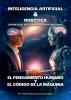
El pensamiento humano y el código de la máquina, tiene la génesis que surge de una inquietud compartida por varios catedráticos universitarios, profesores, tecnólogos y demás pensadores contemporáneos: comprender cómo la inteligencia artificial (IA) y la robótica, dos campos nacidos del ingenio humano, están reconfigurando no solo la práctica educativa, sino también la manera en que concebimos el conocimiento y el aprendizaje.
En los últimos años, hemos sido testigos de una aceleración sin precedentes en el desarrollo de sistemas automatizados e inteligentes. Las aulas, tradicionalmente espacios de interacción humana y reflexión; comienzan a entrelazarse con lenguaje maquinas; como algoritmos, códigos, lista de prompt, asistentes virtuales, robots pedagógicos y plataformas informáticas, que buscan optimizar los procesos de enseñanza aprendizaje; en este sentido, el papel de los profesores, de los estudiantes es importante en esta transformación que no debe ser comprendida únicamente desde la perspectiva tecnológica, sino también desde la dimensión humana, ética y pedagógica.
El propósito de este memorial es precisamente ese: tender un puente entre la racionalidad del código de la máquina y la profundidad del pensamiento humano. No se trata de exaltar la tecnología como fin último, sino de explorar sus posibilidades como herramienta para ampliar las capacidades del pensamiento humano, democratizar el acceso al conocimiento y fomentar la innovación pedagógica: y es ahí, en este instante que nos preguntamos ¿cómo podemos construir una educación más humana en tiempos de máquinas inteligentes?
Este libro no pretende ofrecer respuestas cerradas, sino abrir espacios de debate, reflexión y construcción colectiva. Invita al lector a mirar más allá del brillo de las máquinas y a redescubrir, en medio de la automatización, el valor insustituible de la inteligencia humana que es el factor fundamental de nuestra existencia; y recordemos: quien da las instrucciones es el hombre, quien la acata es la maquina; por consiguiente, nunca una maquina puede ser más potente que nuestra mente
Ainscow M. Booth T. & Dyson A. (2006). Improving schools developing inclusion. Routledge.
Alimisis D. (2013). Educational robotics: Open questions and new challenges. Themes in Science and Technology Education 6(1) 63–71.
Baker R. & Smith L. (2019). Educating in the age of AI: Opportunities and challenges. Routledge.
Barr V. & Stephenson C. (2011). Bringing computational thinking to K–12: What is involved and what is the role of the computer science education community? ACM Inroads 2(1) 48–54. https://doi.org/10.1145/1929887.1929905
Benitti F. B. V. (2012). Exploring the educational potential of robotics in schools: A systematic review. Computers & Education 58(3) 978–988.
https://doi.org/10.1016/j.compedu.2011.10.006
Bers M. U. (2018). Coding as a playground: Programming and computational thinking in the early childhood classroom. Routledge.
Bozkurt A. et al. (2020). A global outlook to the interruption of education due to COVID-19 pandemic: Navigating in a time of uncertainty. Asian Journal of Distance Education 15(1) 1–126.
Broadbent E. Stafford R. & MacDonald B. (2009). Acceptance of healthcare robots for the older population: Review and future directions. International Journal of Social Robotics 1(4) 319–330.
Brown J. S. & Burton R. R. (1978). Diagnostic models for procedural bugs in basic mathematical skills. Cognitive Science 2(2) 155–192.
Brynjolfsson E. & McAfee A. (2014). The second machine age: Work progress and prosperity in a time of brilliant technologies. W. W. Norton & Company.
Denning P. J. (2005). The profession of IT: Is computer science science? Communications of the ACM 48(4) 27–31.
Eguchi A. (2017). Robotics as a learning tool for educational transformation. In Proceedings of the 4th International Workshop Teaching Robotics Teaching with Robotics & 5th International Conference Robotics in Education (RiE) 27–34.
Fallas J. (2025). PC y desarrollo cognitivo en entornos educativos digitales.
Floridi L. Cowls J. Beltrametti M. Chatila R. Chazerand P. Dignum V. … & Vayena E. (2018). AI4People—An ethical framework for a good AI society: Opportunities risks principles and recommendations. Minds and Machines 28(4) 689–707.
Flores L. Rivera P. & Martínez J. (2024). Robótica educativa y motivación en contextos escolares latinoamericanos.
.
Fryer L. K. & Carpenter R. (2018). Bots as language learning partners: Student attitudes and perceptions. Computer Assisted Language Learning 32(8) 1–24.
https://doi.org/10.1080/09588221.2018.1480470
Ganchozo Vidal C. & Micolta Segura M. (2025). Desafíos y oportunidades del profesorado ecuatoriano ante la tecnología. Quito: Editorial Académica.
García M. & Pérez L. (2021). Aprendizaje basado en proyectos con robótica educativa: Un enfoque inclusivo.
Garrison D. R. & Vaughan N. D. (2008). Blended learning in higher education: Framework principles and guidelines. Jossey-Bass.
Goodfellow I. Bengio Y. & Courville A. (2016). Deep learning. MIT Press.
Graham C. R. (2013). Emerging practice and research in blended learning. In M. G. Moore (Ed.) Handbook of distance education (3rd ed. pp. 333–350). Routledge.
Grover S. & Pea R. (2013). Computational thinking in K–12: A review of the state of the field. Educational Researcher 42(1) 38–43. https://doi.org/10.3102/0013189X12463051
Holmes W. Bialik M. & Fadel C. (2019). Artificial intelligence in education: Promises and implications for teaching and learning. Center for Curriculum Redesign.
Holmberg B. (2005). The evolution of the character and practice of distance education. Open Learning 20(2) 121–139.
Horn M. B. & Staker H. (2014). Blended: Using disruptive innovation to improve schools. Jossey-Bass.
International Federation of Robotics (IFR). (2022). World robotics report 2022: Industrial robots. IFR.
Johnson D. W. (2020). Cooperative learning: The foundation for active learning. Active Learning in Higher Education 21(1) 6–24.
Luckin R. Holmes W. Griffiths M. & Forcier L. B. (2016). Intelligence unleashed: An argument for AI in education. Pearson Education.
Mataric M. J. (2007). The robotics primer. MIT Press.
Mubin O. Stevens C. J. Shahid S. Al Mahmud A. & Dong J.-J. (2013). A review of the applicability of robots in education. Technology for Education and Learning 1(1) 1–7.
Nilsson N. J. (2014). Understanding beliefs: An essay on the interface between knowledge and AI. Morgan Kaufmann.
OECD. (2019). OECD learning compass 2030. OECD Publishing.
OECD. (2020). The future of education and skills: Education 2030. OECD Publishing.
OECD. (2020). Teaching in the digital age: Smart pedagogies for better learning. OECD Publishing.
OECD. (2021). AI and the future of skills: Challenges and opportunities. OECD Publishing.
Papert S. (1980). Mindstorms: Children computers and powerful ideas. Basic Books.
Piaget J. (1972). The psychology of the child. Basic Books.
Prince M. (2004). Does active learning work? A review of the research. Journal of Engineering Education 93(3) 223–231.
Prensky M. (2012). From digital natives to digital wisdom: Hopeful essays for 21st century learning. Corwin Press.
ProFuturo. (2024). Competencias digitales docentes en América Latina. Fundación ProFuturo.
Russell S. J. & Norvig P. (2021). Artificial intelligence: A modern approach (4th ed.). Pearson.
Salinas J. (2018). Innovación educativa y uso de las TIC. Revista Universidad y Sociedad del Conocimiento 15(2) 16–31.
Sánchez Palacios D. Rivas M. & Ochoa P. (2024). Inteligencia artificial aplicada a la educación personalizada en América Latina.
Siemens G. & Baker R. S. (2012). Learning analytics and educational data mining: Towards communication and collaboration. Proceedings of the 2nd International Conference on Learning Analytics and Knowledge 252–254.
https://doi.org/10.1145/2330601.2330661
Siciliano B. & Khatib O. (Eds.). (2016). Springer handbook of robotics (2nd ed.). Springer.
Sleeman D. & Brown J. S. (Eds.). (1982). Intelligent tutoring systems. Academic Press.
Suppes P. (1968). Computer-assisted instruction: Status and prospects. Science 160(3828) 295–300.
Turing A. M. (1950). Computing machinery and intelligence. Mind 59(236) 433–460.
https://doi.org/10.1093/mind/LIX.236.433
UNESCO. (1994). The Salamanca Statement and Framework for Action on Special Needs Education. UNESCO Publishing.
UNESCO. (2020). Global Education Monitoring Report: Inclusion and education. UNESCO Publishing.
UNESCO. (2021). Recommendation on the ethics of artificial intelligence. UNESCO Publishing.
UNESCO. (2021). Reimagining our futures together: A new social contract for education. UNESCO Publishing.
UNESCO. (2021). COVID-19 educational disruption and response. UNESCO Publishing.
VanLehn K. (2011). The relative effectiveness of human tutoring intelligent tutoring systems and other tutoring systems. Educational Psychologist 46(4) 197–221.
https://doi.org/10.1080/00461520.2011.611369
Vivanco Maldonado J. (2025). Competencias digitales y formación docente en Ecuador. Universidad Central del Ecuador.
Vygotsky L. S. (1978). Mind in society: The development of higher psychological processes. Harvard University Press.
Wiener N. (1948). Cybernetics: Or control and communication in the animal and the machine. MIT Press.
Williams D. C. Ma Y. Prejean L. Ford M. J. & Lai G. (2007). Acquisition of physics content knowledge and scientific inquiry skills in a robotics summer camp. Journal of Research on Technology in Education 40(2) 201–216.
Wing J. M. (2006). Computational thinking. Communications of the ACM 49(3) 33–35.
Woolf B. P. (2010). Building intelligent interactive tutors: Student-centered strategies for revolutionizing e-learning. Morgan Kaufmann.
Yang G. Z. Cambias J. Cleary K. Daimler E. Drake J. Dupont P. E. ... & Wood B. J. (2020). Medical robotics—Regulatory ethical and legal considerations for increasing levels of autonomy. Science Robotics 5(40) eabb8478.

Esta obra está bajo una licencia internacional Creative Commons Atribución-NoComercial-CompartirIgual 4.0.
No es necesario que cumpla con la licencia para los elementos del material que sean de dominio público o cuando su uso esté permitido por una excepción o limitación aplicable .
No se ofrecen garantías. La licencia podría no otorgarle todos los permisos necesarios para el uso previsto. Por ejemplo, otros derechos, como los de publicidad, privacidad o morales, podrían limitar el uso del material.