https://orcid.org/0000-0001-5425-1057






Digital transformation has become one of the most frequently cited topics in contemporary management and, at the same time, one of the least well understood. A reduced version of the concept circulates in classrooms and in companies, one that confuses it with buying equipment or with being present on social media. This book was written to offer students, teachers and managers a rigorous and usable account of the subject, from a public university on the Ecuadorian coast and with the organizations of the region in mind.
Most of the literature on the topic describes the experience of large corporations in advanced economies. Its concepts are valuable, but its examples rarely resemble the corner shop, the savings cooperative or the transport company that the student knows. The chapters therefore combine the classic frameworks with illustrative cases set in Latin American contexts, where connectivity, financing and skills cannot be taken for granted.
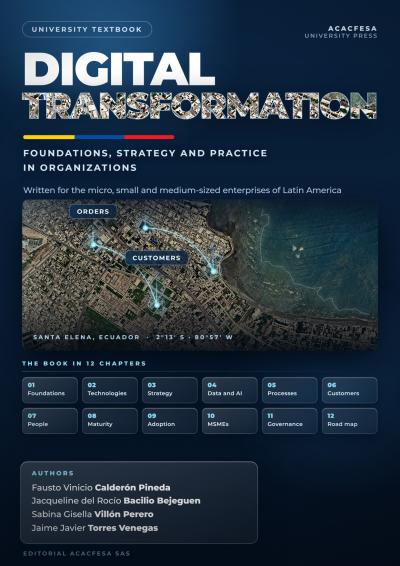
The book covers twelve topics in an order that moves from the conceptual to the applied. The first chapters establish the foundations and the enabling technologies; the following ones address strategy, data, processes, customers and people. Digital maturity, the theories of adoption and the particular situation of micro, small and medium-sized enterprises are studied next, and the closing chapters deal with governance, ethics, security and the road map that makes it possible to move from intention to results.
Every chapter follows the same architecture: learning objectives, development of the topic, an illustrative case, a summary, key terms, exercises and a self-assessment. The reasoned answers to the self-assessments, the worked solutions to the numerical exercises and a set of working templates are given in the appendices. This structure allows the book to be used as the main text of a course, as a reference for degree projects or as a self-study guide for anyone who runs a company.
The authors have sought a balance between rigor and clarity. The sources cited are articles from scientific journals, reference books, reports of international organizations and Ecuadorian legislation in force; the examples are deliberately simple so that attention stays on the reasoning. If, on finishing the book, readers are able to look at an organization and tell the difference between digitalizing a task and transforming a business, the book will have served its purpose.
Abdulaal, A. M. (2026). The impact of digital transformation on the innovation perfor-mance of SME through employees’ digital capabilities: The moderating effect of digital transformation leadership. International Review of Management and Market-ing, 16(3), 105-118. https://doi.org/10.32479/irmm.22807
Adner, R. (2017). Ecosystem as structure: An actionable construct for strategy. Journal of Management, 43(1), 39-58. https://doi.org/10.1177/0149206316678451
Armbrust, M., Fox, A., Griffith, R., Joseph, A. D., Katz, R., Konwinski, A., Lee, G., Patter-son, D., Rabkin, A., Stoica, I., & Zaharia, M. (2010). A view of cloud computing. Communications of the ACM, 53(4), 50-58. https://doi.org/10.1145/1721654.1721672
Asamblea Nacional del Ecuador. (2020). Ley Orgánica de Emprendimiento e Innovación. Registro Oficial Suplemento n.º 151, 28 de febrero de 2020.
Asamblea Nacional del Ecuador. (2021). Ley Orgánica de Protección de Datos Personales. Registro Oficial Quinto Suplemento n.º 459, 26 de mayo de 2021.
Asamblea Nacional del Ecuador. (2023). Ley Orgánica para la Transformación Digital y Audiovisual. Registro Oficial Tercer Suplemento n.º 245, 7 de febrero de 2023.
Atzori, L., Iera, A., & Morabito, G. (2010). The Internet of Things: A survey. Computer Networks, 54(15), 2787-2805. https://doi.org/10.1016/j.comnet.2010.05.010
Autor, D. H. (2015). Why are there still so many jobs? The history and future of workplace automation. Journal of Economic Perspectives, 29(3), 3-30. https://doi.org/10.1257/jep.29.3.3
Barney, J. (1991). Firm resources and sustained competitive advantage. Journal of Man-agement, 17(1), 99-120. https://doi.org/10.1177/014920639101700108
Bayat, M., Hassanzadeh, A., Shayan, A., Ostadi, B., & Hassani, H. (2025). Agile digital transformation in SMEs: A hybrid prioritization approach. Frontiers in Sustainabil-ity, 6, 1618920. https://doi.org/10.3389/frsus.2025.1618920
Becker, J., Knackstedt, R., & Pöppelbuß, J. (2009). Developing maturity models for IT man-agement: A procedure model and its application. Business & Information Systems Engineering, 1(3), 213-222. https://doi.org/10.1007/s12599-009-0044-5
Bharadwaj, A. S. (2000). A resource-based perspective on information technology capabil-ity and firm performance: An empirical investigation. MIS Quarterly, 24(1), 169-196. https://doi.org/10.2307/3250983
Bharadwaj, A., El Sawy, O. A., Pavlou, P. A., & Venkatraman, N. (2013). Digital business strategy: Toward a next generation of insights. MIS Quarterly, 37(2), 471-482. https://doi.org/10.25300/MISQ/2013/37:2.3
Brynjolfsson, E., & Hitt, L. M. (2000). Beyond computation: Information technology, or-ganizational transformation and business performance. Journal of Economic Per-spectives, 14(4), 23-48. https://doi.org/10.1257/jep.14.4.23
Brynjolfsson, E., & McAfee, A. (2014). The second machine age: Work, progress, and prosperity in a time of brilliant technologies. W. W. Norton.
Brynjolfsson, E., & McElheran, K. (2016). The rapid adoption of data-driven decision-making. American Economic Review, 106(5), 133-139. https://doi.org/10.1257/aer.p20161016
Brynjolfsson, E., Li, D., & Raymond, L. (2025). Generative AI at work. The Quarterly Jour-nal of Economics, 140(2), 889-942. https://doi.org/10.1093/qje/qjae044
Büyüközkan, G., & Göçer, F. (2018). Digital supply chain: Literature review and a proposed framework for future research. Computers in Industry, 97, 157-177. https://doi.org/10.1016/j.compind.2018.02.010
Carretero, S., Vuorikari, R., & Punie, Y. (2017). DigComp 2.1: The digital competence framework for citizens with eight proficiency levels and examples of use. Publica-tions Office of the European Union. https://doi.org/10.2760/38842
Casalet, M. (2018). La digitalización industrial: un camino hacia la gobernanza colaborati-va. Estudios de casos (LC/TS.2018/95). Comisión Económica para América Latina y el Caribe. https://hdl.handle.net/11362/44266
Chaffey, D., & Ellis-Chadwick, F. (2019). Digital marketing: Strategy, implementation and practice (7th ed.). Pearson.
Chen, H., Chiang, R. H. L., & Storey, V. C. (2012). Business intelligence and analytics: From big data to big impact. MIS Quarterly, 36(4), 1165-1188. https://doi.org/10.2307/41703503
Cheng, S., Fan, Q., & Dagestani, A. A. (2024). Opening the black box between strategic vi-sion on digitalization and SMEs digital transformation: The mediating role of re-source orchestration. Kybernetes, 53(2), 580-599. https://doi.org/10.1108/K-01-2023-0073
Chesbrough, H. W. (2003). Open innovation: The new imperative for creating and profiting from technology. Harvard Business School Press.
Christensen, C. M. (1997). The innovator's dilemma: When new technologies cause great firms to fail. Harvard Business School Press.
Comisión Económica para América Latina y el Caribe. (2020). Las oportunidades de la dig-italización en América Latina frente al COVID-19. CEPAL. https://hdl.handle.net/11362/45360
Comisión Económica para América Latina y el Caribe. (2021). Tecnologías digitales para un nuevo futuro (LC/TS.2021/43). CEPAL. https://hdl.handle.net/11362/46816
Comisión Económica para América Latina y el Caribe. (2022). Un camino digital para el desarrollo sostenible de América Latina y el Caribe (LC/CMSI.8/3). CEPAL. https://hdl.handle.net/11362/48460
Cosgrove, J., & Cachia, R. (2025). DigComp 3.0: European digital competence framework. Publications Office of the European Union. https://doi.org/10.2760/0001149
Costa Melo, I., Alves Junior, P. N., Queiroz, G. A., Yushimito, W., & Pereira, J. (2023). Do we consider sustainability when we measure small and medium enterprises’ (SMEs’) performance passing through digital transformation? Sustainability, 15(6), 4917. https://doi.org/10.3390/su15064917
Cronbach, L. J. (1951). Coefficient alpha and the internal structure of tests. Psychometrika, 16(3), 297-334. https://doi.org/10.1007/BF02310555
Davenport, T. H., & Harris, J. G. (2007). Competing on analytics: The new science of win-ning. Harvard Business School Press.
Davis, F. D. (1989). Perceived usefulness, perceived ease of use, and user acceptance of information technology. MIS Quarterly, 13(3), 319-340. https://doi.org/10.2307/249008
Diamantopoulos, A., & Winklhofer, H. M. (2001). Index construction with formative indi-cators: An alternative to scale development. Journal of Marketing Research, 38(2), 269-277. https://doi.org/10.1509/jmkr.38.2.269.18845
Díaz-Arancibia, J., Bustamante-Mora, A., Hochstetter-Diez, J., & Ramírez Villegas, G. M. (2025). Systematic mappings on technology adoption in small and medium-sized en-terprises from developing countries: An umbrella review. PeerJ Computer Science, 11, e3395. https://doi.org/10.7717/peerj-cs.3395
Dini, M., Patiño, A., & Gligo, N. (2021). Transformación digital de las mipymes: elementos para el diseño de políticas (Documentos de Proyectos LC/TS.2021/99). Comisión Económica para América Latina y el Caribe. https://hdl.handle.net/11362/47183
Dumas, M., La Rosa, M., Mendling, J., & Reijers, H. A. (2018). Fundamentals of business process management (2nd ed.). Springer. https://doi.org/10.1007/978-3-662-56509-4
Dwivedi, Y. K., Hughes, L., Ismagilova, E., Aarts, G., Coombs, C., Crick, T., Duan, Y., Dwivedi, R., Edwards, J., Eirug, A., Galanos, V., Ilavarasan, P. V., Janssen, M., Jones, P., Kar, A. K., Kizgin, H., Kronemann, B., Lal, B., Lucini, B., . . . Williams, M. D. (2021). Artificial intelligence (AI): Multidisciplinary perspectives on emerg-ing challenges, opportunities, and agenda for research, practice and policy. Interna-tional Journal of Information Management, 57, 101994. https://doi.org/10.1016/j.ijinfomgt.2019.08.002
Edmondson, A. (1999). Psychological safety and learning behavior in work teams. Adminis-trative Science Quarterly, 44(2), 350-383. https://doi.org/10.2307/2666999
Eguia, I., Wilson, J. R., Cuenca-Amigo, M., Mosquera-López, S., & Bohórquez Correa, S. (2025). Barriers to the digital transformation of cultural and creative industry MSMEs: The case of the Basque Country. Competitiveness Review: An International Business Journal, 35(7), 25-44. https://doi.org/10.1108/CR-01-2025-0028
Eisenhardt, K. M., & Martin, J. A. (2000). Dynamic capabilities: What are they? Strategic Management Journal, 21(10-11), 1105-1121. https://doi.org/10.1002/1097-0266(200010/11)21:10/11<1105::AID-SMJ133>3.0.CO;2-E
Eller, R., Alford, P., Kallmünzer, A., & Peters, M. (2020). Antecedents, consequences, and challenges of small and medium-sized enterprise digitalization. Journal of Business Research, 112, 119-127. https://doi.org/10.1016/j.jbusres.2020.03.004
Feroz, A. K., Zo, H., & Chiravuri, A. (2021). Digital transformation and environmental sus-tainability: A review and research agenda. Sustainability, 13(3), 1530. https://doi.org/10.3390/su13031530
Floridi, L., Cowls, J., Beltrametti, M., Chatila, R., Chazerand, P., Dignum, V., Luetge, C., Madelin, R., Pagallo, U., Rossi, F., Schafer, B., Valcke, P., & Vayena, E. (2018). AI4People: An ethical framework for a good AI society: Opportunities, risks, princi-ples, and recommendations. Minds and Machines, 28(4), 689-707. https://doi.org/10.1007/s11023-018-9482-5
Fosso Wamba, S., Akter, S., Edwards, A., Chopin, G., & Gnanzou, D. (2015). How ‘big da-ta’ can make big impact: Findings from a systematic review and a longitudinal case study. International Journal of Production Economics, 165, 234-246. https://doi.org/10.1016/j.ijpe.2014.12.031
Frank, A. G., Dalenogare, L. S., & Ayala, N. F. (2019). Industry 4.0 technologies: Imple-mentation patterns in manufacturing companies. International Journal of Production Economics, 210, 15-26. https://doi.org/10.1016/j.ijpe.2019.01.004
Frey, C. B., & Osborne, M. A. (2017). The future of employment: How susceptible are jobs to computerisation? Technological Forecasting and Social Change, 114, 254-280. https://doi.org/10.1016/j.techfore.2016.08.019
Garzoni, A., De Turi, I., Secundo, G., & Del Vecchio, P. (2020). Fostering digital transfor-mation of SMEs: A four levels approach. Management Decision, 58(8), 1543-1562. https://doi.org/10.1108/MD-07-2019-0939
Gawer, A., & Cusumano, M. A. (2014). Industry platforms and ecosystem innovation. Jour-nal of Product Innovation Management, 31(3), 417-433. https://doi.org/10.1111/jpim.12105
George, G., Merrill, R. K., & Schillebeeckx, S. J. D. (2021). Digital sustainability and en-trepreneurship: How digital innovations are helping tackle climate change and sus-tainable development. Entrepreneurship Theory and Practice, 45(5), 999-1027. https://doi.org/10.1177/1042258719899425
Gupta, M., & George, J. F. (2016). Toward the development of a big data analytics capabil-ity. Information & Management, 53(8), 1049-1064. https://doi.org/10.1016/j.im.2016.07.004
Gyamerah, S., Afshari, L., & Asante, D. (2025). Digital transformation in the SME context: The nexus between leadership, digital capabilities and digital strategy. International Small Business Journal: Researching Entrepreneurship, 43(3), 303-328. https://doi.org/10.1177/02662426251314108
Hafeez, S., Shahzad, K., & De Silva, M. (2025). Enhancing digital transformation in SMEs: The dynamic capabilities of innovation intermediaries within ecosystems. Long Range Planning, 58(3), 102525. https://doi.org/10.1016/j.lrp.2025.102525
Hanelt, A., Bohnsack, R., Marz, D., & Antunes Marante, C. (2021). A systematic review of the literature on digital transformation: Insights and implications for strategy and organizational change. Journal of Management Studies, 58(5), 1159-1197. https://doi.org/10.1111/joms.12639
Hargittai, E. (2002). Second-level digital divide: Differences in people's online skills. First Monday, 7(4). https://doi.org/10.5210/fm.v7i4.942
Heredia, J., Castillo-Vergara, M., Geldes, C., Carbajal Gamarra, F. M., Flores, A., & Here-dia, W. (2022). How do digital capabilities affect firm performance? The mediating role of technological capabilities in the “new normal”. Journal of Innovation & Knowledge, 7(2), 100171. https://doi.org/10.1016/j.jik.2022.100171
Hilbert, M. (2016). Big data for development: A review of promises and challenges. Devel-opment Policy Review, 34(1), 135-174. https://doi.org/10.1111/dpr.12142
Hoang, H. (2024). Navigating the digital landscape: An exploration of the relationship be-tween technology-organization-environment factors and digital transformation adop-tion in SMEs. Sage Open, 14(4), 21582440241276198. https://doi.org/10.1177/21582440241276198
Iacovou, C. L., Benbasat, I., & Dexter, A. S. (1995). Electronic data interchange and small organizations: Adoption and impact of technology. MIS Quarterly, 19(4), 465-485. https://doi.org/10.2307/249629
Ivanov, D., Dolgui, A., & Sokolov, B. (2019). The impact of digital technology and Industry 4.0 on the ripple effect and supply chain risk analytics. International Journal of Production Research, 57(3), 829-846. https://doi.org/10.1080/00207543.2018.1488086
Jobin, A., Ienca, M., & Vayena, E. (2019). The global landscape of AI ethics guidelines. Nature Machine Intelligence, 1(9), 389-399. https://doi.org/10.1038/s42256-019-0088-2
Jordan, M. I., & Mitchell, T. M. (2015). Machine learning: Trends, perspectives, and pro-spects. Science, 349(6245), 255-260. https://doi.org/10.1126/science.aaa8415
Kalverkamp, M., Willimowski, M. C., Wiesner, S., & Zuniga, R. (2024). From vineyard to smart factory: The case for a digital innovation hub in the Atacama Desert. In IFIP Advances in Information and Communication Technology (pp. 3-17). Springer Na-ture Switzerland. https://doi.org/10.1007/978-3-031-71637-9_1
Kane, G. C., Phillips, A. N., Copulsky, J. R., & Andrus, G. R. (2019). The technology falla-cy: How people are the real key to digital transformation. MIT Press.
Kannan, P. K., & Li, H. A. (2017). Digital marketing: A framework, review and research agenda. International Journal of Research in Marketing, 34(1), 22-45. https://doi.org/10.1016/j.ijresmar.2016.11.006
Kaplan, A. M., & Haenlein, M. (2010). Users of the world, unite! The challenges and oppor-tunities of social media. Business Horizons, 53(1), 59-68. https://doi.org/10.1016/j.bushor.2009.09.003
Kaplan, A., & Haenlein, M. (2019). Siri, Siri, in my hand: Who’s the fairest in the land? On the interpretations, illustrations, and implications of artificial intelligence. Business Horizons, 62(1), 15-25. https://doi.org/10.1016/j.bushor.2018.08.004
Kaplan, R. S., & Norton, D. P. (1996). The balanced scorecard: Translating strategy into action. Harvard Business School Press.
Khan, S. U. (2025). Mobile money and financial inclusion: International evidence from in-formal sector enterprises in Asia and Africa. Journal of Asian Economics, 101, 102033. https://doi.org/10.1016/j.asieco.2025.102033
Koca, D., & van Deursen, A. (2026). Exploring labor market dynamics in digital transfor-mations: The perspective of Dutch SMEs. Journal of the International Council for Small Business, 7(3), 940-975. https://doi.org/10.1080/26437015.2025.2538182
Kotler, P., Kartajaya, H., & Setiawan, I. (2017). Marketing 4.0: Moving from traditional to digital. John Wiley & Sons.
Kotter, J. P. (1996). Leading change. Harvard Business School Press.
Kraus, S., Jones, P., Kailer, N., Weinmann, A., Chaparro-Banegas, N., & Roig-Tierno, N. (2021). Digital transformation: An overview of the current state of the art of re-search. Sage Open, 11(3), 21582440211047576. https://doi.org/10.1177/21582440211047576
Lasi, H., Fettke, P., Kemper, H.-G., Feld, T., & Hoffmann, M. (2014). Industry 4.0. Business & Information Systems Engineering, 6(4), 239-242. https://doi.org/10.1007/s12599-014-0334-4
Legner, C., Eymann, T., Hess, T., Matt, C., Böhmann, T., Drews, P., Mädche, A., Urbach, N., & Ahlemann, F. (2017). Digitalization: Opportunity and challenge for the business and information systems engineering community. Business & Information Systems Engineering, 59(4), 301-308. https://doi.org/10.1007/s12599-017-0484-2
Lemon, K. N., & Verhoef, P. C. (2016). Understanding customer experience throughout the customer journey. Journal of Marketing, 80(6), 69-96. https://doi.org/10.1509/jm.15.0420
Leso, B. H., Cortimiglia, M. N., & Ghezzi, A. (2023). The contribution of organizational culture, structure, and leadership factors in the digital transformation of SMEs: A mixed-methods approach. Cognition, Technology & Work, 25(1), 151-179. https://doi.org/10.1007/s10111-022-00714-2
Lewin, K. (1947). Frontiers in group dynamics: Concept, method and reality in social sci-ence; social equilibria and social change. Human Relations, 1(1), 5-41. https://doi.org/10.1177/001872674700100103
Li, L., Su, F., Zhang, W., & Mao, J. (2018). Digital transformation by SME entrepreneurs: A capability perspective. Information Systems Journal, 28(6), 1129-1157. https://doi.org/10.1111/isj.12153
Londoño-Cardozo, J., Restrepo-Sarmiento, J., Palomino-Arias, M. A., Bermudez, C. E. E., & Orozco, C. A. C. (2025). Determinants of dynamic capabilities in vulnerable con-texts: An analysis of MSMEs in Cali’s Comuna 13. RAM. Revista de Administração Mackenzie, 26(6), eRAMD250080. https://doi.org/10.1590/1678-6971/eRAMD250080
Machado Becker, A., Ferreira Da Silva, P., Ayala, N. F., & Zomer, T. (2026). Exploring the factors influencing digital transformation in micro and small-sized enterprises in an emerging country: A sociotechnical systems perspective. International Journal of Productivity and Performance Management, 75(1), 132-152. https://doi.org/10.1108/IJPPM-11-2024-0793
Matt, C., Hess, T., & Benlian, A. (2015). Digital transformation strategies. Business & In-formation Systems Engineering, 57(5), 339-343. https://doi.org/10.1007/s12599-015-0401-5
Mell, P. M., & Grance, T. (2011). The NIST definition of cloud computing (NIST Special Publication 800-145). National Institute of Standards and Technology. https://doi.org/10.6028/NIST.SP.800-145
Melville, N., Kraemer, K., & Gurbaxani, V. (2004). Review: Information technology and organizational performance: An integrative model of IT business value. MIS Quar-terly, 28(2), 283-322. https://doi.org/10.2307/25148636
Mergel, I., Edelmann, N., & Haug, N. (2019). Defining digital transformation: Results from expert interviews. Government Information Quarterly, 36(4), 101385. https://doi.org/10.1016/j.giq.2019.06.002
Mick, M. M. A. P., Kovaleski, J. L., Mick, R. L., & Chiroli, D. M. D. G. (2024). Developing a sustainable digital transformation roadmap for SMEs: Integrating digital maturity and strategic alignment. Sustainability, 16(20), 8745. https://doi.org/10.3390/su16208745
Mikalef, P., Pappas, I. O., Krogstie, J., & Giannakos, M. (2018). Big data analytics capabili-ties: A systematic literature review and research agenda. Information Systems and e-Business Management, 16(3), 547-578. https://doi.org/10.1007/s10257-017-0362-y
Nambisan, S., Lyytinen, K., Majchrzak, A., & Song, M. (2017). Digital innovation man-agement: Reinventing innovation management research in a digital world. MIS Quarterly, 41(1), 223-238. https://doi.org/10.25300/MISQ/2017/41:1.03
National Institute of Standards and Technology. (2024). The NIST cybersecurity framework (CSF) 2.0 (NIST CSWP 29). National Institute of Standards and Technology. https://doi.org/10.6028/NIST.CSWP.29
Nolan, R. L. (1973). Managing the computer resource: A stage hypothesis. Communications of the ACM, 16(7), 399-405. https://doi.org/10.1145/362280.362284
Noy, S., & Zhang, W. (2023). Experimental evidence on the productivity effects of genera-tive artificial intelligence. Science, 381(6654), 187-192. https://doi.org/10.1126/science.adh2586
OECD. (2019). OECD SME and entrepreneurship outlook 2019. OECD Publishing. https://doi.org/10.1787/34907e9c-en
OECD. (2021). The digital transformation of SMEs. OECD Publishing. https://doi.org/10.1787/bdb9256a-en
OECD. (2023). OECD SME and entrepreneurship outlook 2023. OECD Publishing. https://doi.org/10.1787/342b8564-en
Ortolano, L. F., & Gallegos, E. E. (2026). Advancing human-AI collaboration in small and medium-sized enterprises: A systems engineering approach. Systems Engineering, 29(3), 477-494. https://doi.org/10.1002/sys.70031
Osterwalder, A., & Pigneur, Y. (2010). Business model generation: A handbook for vision-aries, game changers, and challengers. John Wiley & Sons.
Parker, G. G., Van Alstyne, M. W., & Choudary, S. P. (2016). Platform revolution: How networked markets are transforming the economy and how to make them work for you. W. W. Norton.
Pelletier, C., & Cloutier, L. M. (2019). Conceptualising digital transformation in SMEs: An ecosystemic perspective. Journal of Small Business and Enterprise Development, 26(6/7), 855-876. https://doi.org/10.1108/JSBED-05-2019-0144
Pingali, S. R., Singha, S., Arunachalam, S., & Pedada, K. (2023). Digital readiness of small and medium enterprises in emerging markets: The construct, propositions, meas-urement, and implications. Journal of Business Research, 164, 113973. https://doi.org/10.1016/j.jbusres.2023.113973
Pinto, R., & Gonçalves, G. (2026). From readiness to action: An operational research framework supporting Portuguese SME digital transformation. In Proceedings of the 15th International Conference on Operations Research and Enterprise Systems (pp. 430-437). SCITEPRESS - Science and Technology Publications. https://doi.org/10.5220/0014418800004055
Podsakoff, P. M., MacKenzie, S. B., Lee, J.-Y., & Podsakoff, N. P. (2003). Common method biases in behavioral research: A critical review of the literature and recommended remedies. Journal of Applied Psychology, 88(5), 879-903. https://doi.org/10.1037/0021-9010.88.5.879
Porter, M. E. (1985). Competitive advantage: Creating and sustaining superior perfor-mance. Free Press.
Porter, M. E. (1990). The competitive advantage of nations. Free Press.
Project Management Institute. (2021). A guide to the project management body of knowledge (PMBOK guide) (7th ed.). Project Management Institute.
Provost, F., & Fawcett, T. (2013). Data science and its relationship to big data and data-driven decision making. Big Data, 1(1), 51-59. https://doi.org/10.1089/big.2013.1508
Quenum, G. G. Y., Vallée, S., & Ertz, M. (2025). The digital maturity of small- and medi-um-sized enterprises in the Saguenay-Lac-Saint-Jean region. Machines, 13(9), 835. https://doi.org/10.3390/machines13090835
Ramdani, B., Boukrami, E., & Belaid, F. (2022). Policies and programs to stimulate digital transformation among SMEs: Where do we go from here? En Innovation, Technolo-gy, and Knowledge Management (pp. 89-104). Springer International Publishing. https://doi.org/10.1007/978-3-031-10119-9_5
Reis, J., Amorim, M., Melão, N., & Matos, P. (2018). Digital transformation: A literature review and guidelines for future research. In Advances in Intelligent Systems and Computing (pp. 411-421). Springer International Publishing. https://doi.org/10.1007/978-3-319-77703-0_41
Restrepo-Morales, J. A., Ararat-Herrera, J. A., López-Cadavid, D. A., & Camacho-Vargas, A. (2024). Breaking the digitalization barrier for SMEs: A fuzzy logic approach to overcoming challenges in business transformation. Journal of Innovation and Entre-preneurship, 13(1), 84. https://doi.org/10.1186/s13731-024-00429-w
Rochet, J.-C., & Tirole, J. (2003). Platform competition in two-sided markets. Journal of the European Economic Association, 1(4), 990-1029. https://doi.org/10.1162/154247603322493212
Rogers, D. L. (2016). The digital transformation playbook: Rethink your business for the digital age. Columbia University Press.
Rogers, E. M. (2003). Diffusion of innovations (5th ed.). Free Press.
Ross, J. W., Beath, C. M., & Mocker, M. (2019). Designed for digital: How to architect your business for sustained success. MIT Press.
Rossit, D., & Bidanda, B. (2026). A frugal engineering approach to foster digital transfor-mation in emerging countries: A digital inventory management case study. Interna-tional Journal of Industrial Engineering and Management, 17(1), 39-54. https://doi.org/10.24867/IJIEM-402
Rowley, J. (2007). The wisdom hierarchy: Representations of the DIKW hierarchy. Journal of Information Science, 33(2), 163-180. https://doi.org/10.1177/0165551506070706
Russell, S., & Norvig, P. (2021). Artificial intelligence: A modern approach (4th ed.). Pear-son.
Rust, R. T. (2020). The future of marketing. International Journal of Research in Market-ing, 37(1), 15-26. https://doi.org/10.1016/j.ijresmar.2019.08.002
Schein, E. H. (2010). Organizational culture and leadership (4th ed.). Jossey-Bass.
Schumacher, A., Erol, S., & Sihn, W. (2016). A maturity model for assessing Industry 4.0 readiness and maturity of manufacturing enterprises. Procedia CIRP, 52, 161-166. https://doi.org/10.1016/j.procir.2016.07.040
Schwab, K. (2016). The fourth industrial revolution. World Economic Forum.
Silva, R., Mamede, H. S., & Santos, V. (2023). Clarification of the present understanding of the assessment of an organization’s digital readiness in SMEs. Emerging Science Journal, 7(6), 2279-2307. https://doi.org/10.28991/ESJ-2023-07-06-025
Sirinanda, M. D., & Balota, J. E. (2024). Practical digital transformation framework for small and medium-sized enterprises in the UK. In 2024 IEEE International Confer-ence on e-Business Engineering (ICEBE) (pp. 168-174). IEEE. https://doi.org/10.1109/ICEBE62490.2024.00034
Syed, R., Suriadi, S., Adams, M., Bandara, W., Leemans, S. J., Ouyang, C., ter Hofstede, A. H., van de Weerd, I., Wynn, M. T., & Reijers, H. A. (2020). Robotic process automa-tion: Contemporary themes and challenges. Computers in Industry, 115, 103162. https://doi.org/10.1016/j.compind.2019.103162
Tapscott, D. (1996). The digital economy: Promise and peril in the age of networked intelli-gence. McGraw-Hill.
Teece, D. J. (2007). Explicating dynamic capabilities: The nature and microfoundations of (sustainable) enterprise performance. Strategic Management Journal, 28(13), 1319-1350. https://doi.org/10.1002/smj.640
Teece, D. J. (2010). Business models, business strategy and innovation. Long Range Plan-ning, 43(2-3), 172-194. https://doi.org/10.1016/j.lrp.2009.07.003
Teece, D. J., Pisano, G., & Shuen, A. (1997). Dynamic capabilities and strategic manage-ment. Strategic Management Journal, 18(7), 509-533. https://doi.org/10.1002/(SICI)1097-0266(199708)18:7<509::AID-SMJ882>3.0.CO;2-Z
Teichert, R. (2019). Digital transformation maturity: A systematic review of literature. Acta Universitatis Agriculturae et Silviculturae Mendelianae Brunensis, 67(6), 1673-1687. https://doi.org/10.11118/actaun201967061673
Tiron-Tudor, A., & Deliu, D. (2025). The sustainability performance of SMEs in Industry 5.0: A proposal for a synergetic digital sustainable development maturity model (SDSDMM). Eastern European Economics, 63(5), 739-783. https://doi.org/10.1080/00128775.2024.2442306
Tornatzky, L. G., & Fleischer, M. (1990). The processes of technological innovation. Lex-ington Books.
Touijer, M. N., & Elabjani, A. (2025). A Delphi study on digital maturity and digital com-petitiveness in the context of digital transformation. Journal of Enterprising Com-munities: People and Places in the Global Economy, 19(2), 386-409. https://doi.org/10.1108/JEC-05-2024-0088
Treiblmaier, H. (2018). The impact of the blockchain on the supply chain: A theory-based research framework and a call for action. Supply Chain Management: An Interna-tional Journal, 23(6), 545-559. https://doi.org/10.1108/SCM-01-2018-0029
van der Aalst, W. (2016). Process mining: Data science in action (2nd ed.). Springer. https://doi.org/10.1007/978-3-662-49851-4
van der Aalst, W. M. P., Bichler, M., & Heinzl, A. (2018). Robotic process automation. Business & Information Systems Engineering, 60(4), 269-272. https://doi.org/10.1007/s12599-018-0542-4
van Dijk, J. (2020). The digital divide. Polity Press.
Venkatesh, V., Morris, M. G., Davis, G. B., & Davis, F. D. (2003). User acceptance of in-formation technology: Toward a unified view. MIS Quarterly, 27(3), 425-478. https://doi.org/10.2307/30036540
Venkatesh, V., Thong, J. Y. L., & Xu, X. (2012). Consumer acceptance and use of infor-mation technology: Extending the unified theory of acceptance and use of technolo-gy. MIS Quarterly, 36(1), 157-178. https://doi.org/10.2307/41410412
Verhoef, P. C., Broekhuizen, T., Bart, Y., Bhattacharya, A., Qi Dong, J., Fabian, N., & Haen-lein, M. (2021). Digital transformation: A multidisciplinary reflection and research agenda. Journal of Business Research, 122, 889-901. https://doi.org/10.1016/j.jbusres.2019.09.022
Verhoef, P. C., Kannan, P., & Inman, J. J. (2015). From multi-channel retailing to omni-channel retailing. Journal of Retailing, 91(2), 174-181. https://doi.org/10.1016/j.jretai.2015.02.005
Vial, G. (2019). Understanding digital transformation: A review and a research agenda. The Journal of Strategic Information Systems, 28(2), 118-144. https://doi.org/10.1016/j.jsis.2019.01.003
Vuorikari, R., Kluzer, S., & Punie, Y. (2022). DigComp 2.2: The digital competence frame-work for citizens. With new examples of knowledge, skills and attitudes. Publications Office of the European Union. https://doi.org/10.2760/115376
Wade, M., & Hulland, J. (2004). Review: The resource-based view and information systems research: Review, extension, and suggestions for future research. MIS Quarterly, 28(1), 107-142. https://doi.org/10.2307/25148626
Wang, K., Xu, X., Mao, P., Deng, X., & Cao, D. (2026). Digital transformation and organi-zational readiness: Evidence from Chinese construction SMEs with a dynamic man-agerial capabilities lens. Engineering, Construction and Architectural Management, 33(7), 5783-5819. https://doi.org/10.1108/ECAM-01-2025-0069
Warner, K. S., & Wäger, M. (2019). Building dynamic capabilities for digital transfor-mation: An ongoing process of strategic renewal. Long Range Planning, 52(3), 326-349. https://doi.org/10.1016/j.lrp.2018.12.001
Weill, P., & Ross, J. W. (2004). IT governance: How top performers manage IT decision rights for superior results. Harvard Business School Press.
Westerman, G., Bonnet, D., & McAfee, A. (2014). Leading digital: Turning technology into business transformation. Harvard Business Review Press.
World Bank. (2016). World development report 2016: Digital dividends. World Bank. https://doi.org/10.1596/978-1-4648-0671-1
Xu, L. D., He, W., & Li, S. (2014). Internet of Things in industries: A survey. IEEE Trans-actions on Industrial Informatics, 10(4), 2233-2243. https://doi.org/10.1109/TII.2014.2300753
Yang, Z., Hu, H., & Zhang, Z. (2026). Technological breakthroughs vs organizational change: Who’s driving the digital future of SMEs? Evidence from resource orches-tration. Journal of Organizational Change Management, 39(2), 387-413. https://doi.org/10.1108/JOCM-11-2024-0745
Yoo, Y., Henfridsson, O., & Lyytinen, K. (2010). Research commentary: The new organiz-ing logic of digital innovation: An agenda for information systems research. Infor-mation Systems Research, 21(4), 724-735. https://doi.org/10.1287/isre.1100.0322
Zott, C., Amit, R., & Massa, L. (2011). The business model: Recent developments and fu-ture research. Journal of Management, 37(4), 1019-1042. https://doi.org/10.1177/0149206311406265
Zuboff, S. (2019). The age of surveillance capitalism: The fight for a human future at the new frontier of power. PublicAffairs.

Esta obra está bajo una licencia internacional Creative Commons Atribución-NoComercial-CompartirIgual 4.0.
No es necesario que cumpla con la licencia para los elementos del material que sean de dominio público o cuando su uso esté permitido por una excepción o limitación aplicable .
No se ofrecen garantías. La licencia podría no otorgarle todos los permisos necesarios para el uso previsto. Por ejemplo, otros derechos, como los de publicidad, privacidad o morales, podrían limitar el uso del material.