https://orcid.org/0000-0001-5425-1057






Las pequeñas y medianas empresas sostienen buena parte del empleo y de la actividad económica de la provincia de Santa Elena, pero rara vez son objeto de estudios que midan con precisión cómo incorporan la tecnología y qué obtienen de ella. Este libro reúne los resultados de un proyecto de investigación de la Universidad Estatal Península de Santa Elena que se propuso precisamente eso: medir, explicar y proponer a partir de datos recogidos empresa por empresa.
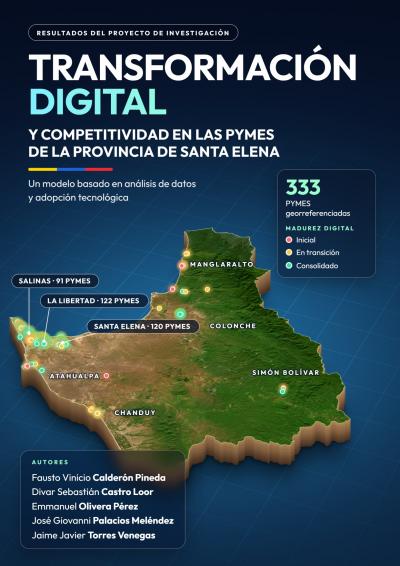
El lector encontrará aquí algo poco frecuente en la literatura regional: un diagnóstico de 333 empresas georreferenciadas y verificadas sobre imagen satelital, un índice de madurez digital cuya regla de cálculo se publica completa y un panel financiero de tres ejercicios que permite contrastar la madurez con el desempeño. Todas las cifras proceden de una misma rutina de cálculo sobre la base depurada, así que cualquier resultado puede reproducirse y auditarse.
Los hallazgos desafían varias ideas extendidas. La conectividad ya no es el principal obstáculo, porque el 77,5 % de las empresas dispone de internet; la madurez digital media, de 63,5 puntos sobre 100, es intermedia y muy dispersa; y lo que más la distingue no es el cantón ni el tamaño de la empresa, sino la formación de quien la dirige. La madurez se asocia con la rentabilidad y no con el crecimiento de los ingresos, y una parte de esa relación, el 34,5 %, transcurre a través de las capacidades dinámicas de la organización.
Las entrevistas a trece empresarios turísticos ponen voz a esas cifras: todos consideran importante la tecnología y la usan como vitrina, pero la gestión sigue anotándose a mano o en sistemas aislados en la mayoría de los negocios. Con esa evidencia, la obra propone un modelo contextualizado de transformación digital, con rutas de intervención diferenciadas según el nivel de madurez y el perfil de cada empresa, y formula recomendaciones para las propias empresas, los gremios, la universidad y los distintos niveles de gobierno.
Los autores han sido explícitos sobre los límites del trabajo. La intervención piloto y la validación del modelo por expertos forman parte del diseño del proyecto, pero sus resultados no se incluyen en esta edición, y la fase cualitativa se limita a trece negocios turísticos. Esa franqueza es también una invitación: el diagnóstico queda disponible como línea base para medir, en los próximos años, cuánto avanza la transformación digital en la provincia.
Abdulaal, A. M. (2026). The impact of digital transformation on the innovation performance of SME through employees’ digital capabilities: The moderating effect of digital transformation leadership. International Review of Management and Marketing, 16(3), 105-118. https://doi.org/10.32479/irmm.22807
Asa, A. R., Nautwima, J. P., & Johannes, H. N. (2026). The transformative impact of digital technology on SME performance: A review and framework for digital transfor-mation. Cogent Business & Management, 13(1), 2643949. https://doi.org/10.1080/23311975.2026.2643949
Asamblea Nacional del Ecuador. (2021). Ley Orgánica de Protección de Datos Personales. Registro Oficial Quinto Suplemento n.º 459, 26 de mayo de 2021.
Asamblea Nacional del Ecuador. (2023). Ley Orgánica para la Transformación Digital y Audiovisual. Registro Oficial Tercer Suplemento n.º 245, 7 de febrero de 2023.
Bai, Z., Ge, J., Zhang, D., & Zhang, Y. (2026). Digital infrastructure and export of SMEs: Evidence from China. Small Business Economics, 66(4), 1875-1900. https://doi.org/10.1007/s11187-025-01165-5
Barney, J. (1991). Firm resources and sustained competitive advantage. Journal of Manage-ment, 17(1), 99-120. https://doi.org/10.1177/014920639101700108
Bartlett, M. S. (1950). Tests of significance in factor analysis. British Journal of Statistical Psychology, 3(2), 77-85. https://doi.org/10.1111/j.2044-8317.1950.tb00285.x
Becker, J., Knackstedt, R., & Pöppelbuß, J. (2009). Developing maturity models for IT man-agement: A procedure model and its application. Business & Information Systems Engineering, 1(3), 213-222. https://doi.org/10.1007/s12599-009-0044-5
Bennacer, M. K., El Mahdi, E. M., & Lahmouchi, M. (2025). Digital transformation in Mo-roccan SMEs: Overcoming barriers and achieving growth. TEM Journal, 14(2), 1269-1278. https://doi.org/10.18421/TEM142-28
Bharadwaj, A. S. (2000). A resource-based perspective on information technology capability and firm performance: An empirical investigation. MIS Quarterly, 24(1), 169-196. https://doi.org/10.2307/3250983
Brynjolfsson, E., & Hitt, L. M. (2000). Beyond computation: Information technology, organ-izational transformation and business performance. Journal of Economic Perspec-tives, 14(4), 23-48. https://doi.org/10.1257/jep.14.4.23
Brynjolfsson, E., Li, D., & Raymond, L. (2025). Generative AI at work. The Quarterly Jour-nal of Economics, 140(2), 889-942. https://doi.org/10.1093/qje/qjae044
Cheng, S., Fan, Q., & Dagestani, A. A. (2024). Opening the black box between strategic vi-sion on digitalization and SMEs digital transformation: The mediating role of re-source orchestration. Kybernetes, 53(2), 580-599. https://doi.org/10.1108/K-01-2023-0073
Cohen, J. (1988). Statistical power analysis for the behavioral sciences (2.ª ed.). Lawrence Erlbaum Associates.
Cong, N. N., & Mai, L. N. T. (2025). Factors influencing the digital transformation of Vi-etnam SMEs. International Journal of Analysis and Applications, 23, 259. https://doi.org/10.28924/2291-8639-23-2025-259
Costa Melo, I., Alves Junior, P. N., Queiroz, G. A., Yushimito, W., & Pereira, J. (2023). Do we consider sustainability when we measure small and medium enterprises’ (SMEs’) performance passing through digital transformation? Sustainability, 15(6), 4917. https://doi.org/10.3390/su15064917
Creswell, J. W., & Plano Clark, V. L. (2018). Designing and conducting mixed methods re-search (3.ª ed.). SAGE.
Cronbach, L. J. (1951). Coefficient alpha and the internal structure of tests. Psychometrika, 16(3), 297-334. https://doi.org/10.1007/BF02310555
Davis, F. D. (1989). Perceived usefulness, perceived ease of use, and user acceptance of in-formation technology. MIS Quarterly, 13(3), 319-340. https://doi.org/10.2307/249008
Davis, S. J., & Haltiwanger, J. (1992). Gross job creation, gross job destruction, and em-ployment reallocation. The Quarterly Journal of Economics, 107(3), 819-863. https://doi.org/10.2307/2118365
Diamantopoulos, A., & Winklhofer, H. M. (2001). Index construction with formative indica-tors: An alternative to scale development. Journal of Marketing Research, 38(2), 269-277. https://doi.org/10.1509/jmkr.38.2.269.18845
Díaz-Arancibia, J., Bustamante-Mora, A., Hochstetter-Diez, J., & Ramírez Villegas, G. M. (2025). Systematic mappings on technology adoption in small and medium-sized en-terprises from developing countries: An umbrella review. PeerJ Computer Science, 11, e3395. https://doi.org/10.7717/peerj-cs.3395
Dini, M., Patiño, A., & Gligo, N. (2021). Transformación digital de las mipymes: elementos para el diseño de políticas (Documentos de Proyectos LC/TS.2021/99). Comisión Económica para América Latina y el Caribe. https://hdl.handle.net/11362/47183
Eguia, I., Wilson, J. R., Cuenca-Amigo, M., Mosquera-López, S., & Bohórquez Correa, S. (2025). Barriers to the digital transformation of cultural and creative industry MSMEs: The case of the Basque Country. Competitiveness Review: An International Business Journal, 35(7), 25-44. https://doi.org/10.1108/CR-01-2025-0028
Eisenhardt, K. M., & Martin, J. A. (2000). Dynamic capabilities: What are they? Strategic Management Journal, 21(10-11), 1105-1121. https://doi.org/10.1002/1097-0266(200010/11)21:10/11<1105::AID-SMJ133>3.0.CO;2-E
Eller, R., Alford, P., Kallmünzer, A., & Peters, M. (2020). Antecedents, consequences, and challenges of small and medium-sized enterprise digitalization. Journal of Business Research, 112, 119-127. https://doi.org/10.1016/j.jbusres.2020.03.004
Fetters, M. D., Curry, L. A., & Creswell, J. W. (2013). Achieving integration in mixed meth-ods designs: Principles and practices. Health Services Research, 48(6pt2), 2134-2156. https://doi.org/10.1111/1475-6773.12117
Freeman, J., Park, S., Middleton, C., & Allen, M. (2016). The importance of broadband for socio-economic development: A perspective from rural Australia. Australasian Journal of Information Systems, 20. https://doi.org/10.3127/AJIS.V20I0.1192
Friese, S. (2019). Qualitative data analysis with ATLAS.ti (3.ª ed.). SAGE.
Garzoni, A., De Turi, I., Secundo, G., & Del Vecchio, P. (2020). Fostering digital transfor-mation of SMEs: A four levels approach. Management Decision, 58(8), 1543-1562. https://doi.org/10.1108/MD-07-2019-0939
Gilani, S. A. M., Yasin, N., Duncan, P., & Smith, A. M. (2024). What is remote-rural and why is it important? World Review of Entrepreneurship, Management and Sustaina-ble Development, 20(5), 517-537. https://doi.org/10.1504/WREMSD.2024.140706
Gómez García, L. D., Zambrano Aranda, G. M., & Toledo Concha, E. J. (2026). Beyond the counter: Unveiling the financial informality dynamics of female entrepreneurs in Lima’s bodega sector. Journal of Small Business and Enterprise Development, 33(2), 428-450. https://doi.org/10.1108/JSBED-03-2024-0172
Gyamerah, S., Afshari, L., & Asante, D. (2025). Digital transformation in the SME context: The nexus between leadership, digital capabilities and digital strategy. International Small Business Journal: Researching Entrepreneurship, 43(3), 303-328. https://doi.org/10.1177/02662426251314108
Hafeez, S., Shahzad, K., & De Silva, M. (2025). Enhancing digital transformation in SMEs: The dynamic capabilities of innovation intermediaries within ecosystems. Long Range Planning, 58(3), 102525. https://doi.org/10.1016/j.lrp.2025.102525
Hair, J. F., Black, W. C., Babin, B. J., & Anderson, R. E. (2019). Multivariate data analysis (8.ª ed.). Cengage.
Hanelt, A., Bohnsack, R., Marz, D., & Antunes Marante, C. (2021). A systematic review of the literature on digital transformation: Insights and implications for strategy and or-ganizational change. Journal of Management Studies, 58(5), 1159-1197. https://doi.org/10.1111/joms.12639
Hargittai, E. (2002). Second-level digital divide: Differences in people's online skills. First Monday, 7(4). https://doi.org/10.5210/fm.v7i4.942
Hayes, A. F. (2018). Introduction to mediation, moderation, and conditional process analy-sis: A regression-based approach (2.ª ed.). Guilford Press.
Heredia, J., Castillo-Vergara, M., Geldes, C., Carbajal Gamarra, F. M., Flores, A., & Here-dia, W. (2022). How do digital capabilities affect firm performance? The mediating role of technological capabilities in the “new normal”. Journal of Innovation & Knowledge, 7(2), 100171. https://doi.org/10.1016/j.jik.2022.100171
Hernández-Sampieri, R., & Mendoza, C. P. (2018). Metodología de la investigación: Las rutas cuantitativa, cualitativa y mixta. McGraw-Hill Interamericana.
Hoang, H. (2024). Navigating the digital landscape: An exploration of the relationship be-tween technology-organization-environment factors and digital transformation adop-tion in SMEs. Sage Open, 14(4), 21582440241276198. https://doi.org/10.1177/21582440241276198
Hubert, L., & Arabie, P. (1985). Comparing partitions. Journal of Classification, 2(1), 193-218. https://doi.org/10.1007/BF01908075
Iacovou, C. L., Benbasat, I., & Dexter, A. S. (1995). Electronic data interchange and small organizations: Adoption and impact of technology. MIS Quarterly, 19(4), 465-485. https://doi.org/10.2307/249629
Instituto Nacional de Estadística y Censos. (2024). Registro Estadístico de Empresas 2023 (Boletín Técnico n.º 01-2024-REEM). INEC. https://www.ecuadorencifras.gob.ec/documentos/web-inec/Estadisticas_Economicas/Registro_Empresas_Establecimientos/2023/Semestre_I/Boletin_REEM_2023.pdf
Jain, A. K. (2010). Data clustering: 50 years beyond K-means. Pattern Recognition Letters, 31(8), 651-666. https://doi.org/10.1016/j.patrec.2009.09.011
Jankulović, A., & Kovačević, A. (2026). Transition readiness from the traditional to the digitalization economy. Journal of the International Council for Small Business, 7(5), 1953-1971. https://doi.org/10.1080/26437015.2025.2589431
Kaiser, H. F. (1974). An index of factorial simplicity. Psychometrika, 39(1), 31-36. https://doi.org/10.1007/BF02291575
Kane, G. C., Phillips, A. N., Copulsky, J. R., & Andrus, G. R. (2019). The technology fallacy: How people are the real key to digital transformation. MIT Press.
Koca, D., & van Deursen, A. (2026). Exploring labor market dynamics in digital transfor-mations: The perspective of Dutch SMEs. Journal of the International Council for Small Business, 7(3), 940-975. https://doi.org/10.1080/26437015.2025.2538182
Kraus, S., Jones, P., Kailer, N., Weinmann, A., Chaparro-Banegas, N., & Roig-Tierno, N. (2021). Digital transformation: An overview of the current state of the art of re-search. Sage Open, 11(3), 21582440211047576. https://doi.org/10.1177/21582440211047576
Krejcie, R. V., & Morgan, D. W. (1970). Determining sample size for research activities. Educational and Psychological Measurement, 30(3), 607-610. https://doi.org/10.1177/001316447003000308
Kruskal, W. H., & Wallis, W. A. (1952). Use of ranks in one-criterion variance analysis. Journal of the American Statistical Association, 47(260), 583-621. https://doi.org/10.1080/01621459.1952.10483441
Legner, C., Eymann, T., Hess, T., Matt, C., Böhmann, T., Drews, P., Mädche, A., Urbach, N., & Ahlemann, F. (2017). Digitalization: Opportunity and challenge for the business and information systems engineering community. Business & Information Systems Engineering, 59(4), 301-308. https://doi.org/10.1007/s12599-017-0484-2
Leso, B. H., Cortimiglia, M. N., & Ghezzi, A. (2023). The contribution of organizational culture, structure, and leadership factors in the digital transformation of SMEs: A mixed-methods approach. Cognition, Technology & Work, 25(1), 151-179. https://doi.org/10.1007/s10111-022-00714-2
Li, L., Su, F., Zhang, W., & Mao, J. (2018). Digital transformation by SME entrepreneurs: A capability perspective. Information Systems Journal, 28(6), 1129-1157. https://doi.org/10.1111/isj.12153
Lincoln, Y. S., & Guba, E. G. (1985). Naturalistic inquiry. SAGE.
Londoño-Cardozo, J., Restrepo-Sarmiento, J., Palomino-Arias, M. A., Bermudez, C. E. E., & Orozco, C. A. C. (2025). Determinants of dynamic capabilities in vulnerable con-texts: An analysis of MSMEs in Cali’s Comuna 13. RAM. Revista de Administração Mackenzie, 26(6), eRAMD250080. https://doi.org/10.1590/1678-6971/eRAMD250080
Machado Becker, A., Ferreira Da Silva, P., Ayala, N. F., & Zomer, T. (2026). Exploring the factors influencing digital transformation in micro and small-sized enterprises in an emerging country: A sociotechnical systems perspective. International Journal of Productivity and Performance Management, 75(1), 132-152. https://doi.org/10.1108/IJPPM-11-2024-0793
Mai, B. T., Nguyen, P. V., Ton, U. N. H., & Ahmed, Z. U. (2024). Government policy, IT capabilities, digital transformation, and innovativeness in post-COVID context: Case of Vietnamese SMEs. International Journal of Organizational Analysis, 32(2), 333-356. https://doi.org/10.1108/IJOA-11-2022-3480
Malterud, K., Siersma, V. D., & Guassora, A. D. (2016). Sample size in qualitative interview studies: Guided by information power. Qualitative Health Research, 26(13), 1753-1760. https://doi.org/10.1177/1049732315617444
Mann, H. B., & Whitney, D. R. (1947). On a test of whether one of two random variables is stochastically larger than the other. The Annals of Mathematical Statistics, 18(1), 50-60. https://doi.org/10.1214/aoms/1177730491
Matt, C., Hess, T., & Benlian, A. (2015). Digital transformation strategies. Business & In-formation Systems Engineering, 57(5), 339-343. https://doi.org/10.1007/s12599-015-0401-5
Mekuria, F., Mzyece, M., Mfupe, L., & Odusola, A. (2021). Affordable connectivity and digital entrepreneurial ecosystem for rural Africa. En 2021 IEEE AFRICON (pp. 1-6). IEEE. https://doi.org/10.1109/AFRICON51333.2021.9570984
Mell, P. M., & Grance, T. (2011). The NIST definition of cloud computing (NIST Special Publication 800-145). National Institute of Standards and Technology. https://doi.org/10.6028/NIST.SP.800-145
Melville, N., Kraemer, K., & Gurbaxani, V. (2004). Review: Information technology and organizational performance: An integrative model of IT business value. MIS Quar-terly, 28(2), 283-322. https://doi.org/10.2307/25148636
Mick, M. M. A. P., Kovaleski, J. L., Mick, R. L., & Chiroli, D. M. D. G. (2024). Developing a sustainable digital transformation roadmap for SMEs: Integrating digital maturity and strategic alignment. Sustainability, 16(20), 8745. https://doi.org/10.3390/su16208745
Mokhatla, P., Bahta, Y. T., & Jordaan, H. (2026). A data-driven, tiered business support framework for small, medium, and micro-agro-processing enterprises in South Afri-ca. Sustainability, 18(6), 2754. https://doi.org/10.3390/su18062754
Mwansa, G., Ngandu, M. R., & Mkwambi, Z. (2025). Bridging the digital divide: Exploring the challenges and solutions for digital exclusion in rural South Africa. Discover Global Society, 3(1), 54. https://doi.org/10.1007/s44282-025-00189-2
National Institute of Standards and Technology. (2024). The NIST cybersecurity framework (CSF) 2.0 (NIST CSWP 29). National Institute of Standards and Technology. https://doi.org/10.6028/NIST.CSWP.29
Nolan, R. L. (1973). Managing the computer resource: A stage hypothesis. Communications of the ACM, 16(7), 399-405. https://doi.org/10.1145/362280.362284
Norris, L. (2020). The spatial implications of rural business digitalization: Case studies from Wales. Regional Studies, Regional Science, 7(1), 499-510. https://doi.org/10.1080/21681376.2020.1841674
Noy, S., & Zhang, W. (2023). Experimental evidence on the productivity effects of genera-tive artificial intelligence. Science, 381(6654), 187-192. https://doi.org/10.1126/science.adh2586
Obokoh, L., Arogundade, S., Sthembiso, N., & Akinola, S. (2024). The effect of digital transformation on the productivity of business enterprises in South Africa. Journal of Infrastructure Policy and Development, 8(5), 3114. https://doi.org/10.24294/jipd.v8i5.3114
OECD. (2021). The digital transformation of SMEs. OECD Publishing. https://doi.org/10.1787/bdb9256a-en
Pelletier, C., & Cloutier, L. M. (2019). Conceptualising digital transformation in SMEs: An ecosystemic perspective. Journal of Small Business and Enterprise Development, 26(6/7), 855-876. https://doi.org/10.1108/JSBED-05-2019-0144
Pelletier, C., L'Écuyer, F., & Raymond, L. (2025). Building organizational agility through digital transformation: A configurational approach in SMEs. Industrial Management & Data Systems, 125(4), 1503-1529. https://doi.org/10.1108/IMDS-05-2024-0488
Peng, Y., & Tao, C. (2022). Can digital transformation promote enterprise performance? From the perspective of public policy and innovation. Journal of Innovation & Knowledge, 7(3), 100198. https://doi.org/10.1016/j.jik.2022.100198
Pingali, S. R., Singha, S., Arunachalam, S., & Pedada, K. (2023). Digital readiness of small and medium enterprises in emerging markets: The construct, propositions, measure-ment, and implications. Journal of Business Research, 164, 113973. https://doi.org/10.1016/j.jbusres.2023.113973
Podsakoff, P. M., MacKenzie, S. B., Lee, J.-Y., & Podsakoff, N. P. (2003). Common method biases in behavioral research: A critical review of the literature and recommended remedies. Journal of Applied Psychology, 88(5), 879-903. https://doi.org/10.1037/0021-9010.88.5.879
Porter, M. E. (1985). Competitive advantage: Creating and sustaining superior performance. Free Press.
Porter, M. E. (1990). The competitive advantage of nations. Free Press.
Preacher, K. J., & Hayes, A. F. (2008). Asymptotic and resampling strategies for assessing and comparing indirect effects in multiple mediator models. Behavior Research Methods, 40(3), 879-891. https://doi.org/10.3758/BRM.40.3.879
Quenum, G. G. Y., Vallée, S., & Ertz, M. (2025). The digital maturity of small- and medi-um-sized enterprises in the Saguenay-Lac-Saint-Jean region. Machines, 13(9), 835. https://doi.org/10.3390/machines13090835
Radicic, D., & Petković, S. (2023). Impact of digitalization on technological innovations in small and medium-sized enterprises (SMEs). Technological Forecasting and Social Change, 191, 122474. https://doi.org/10.1016/j.techfore.2023.122474
Ramdani, B., Boukrami, E., & Belaid, F. (2022). Policies and programs to stimulate digital transformation among SMEs: Where do we go from here? En Innovation, Technolo-gy, and Knowledge Management (pp. 89-104). Springer International Publishing. https://doi.org/10.1007/978-3-031-10119-9_5
Restrepo-Morales, J. A., Ararat-Herrera, J. A., López-Cadavid, D. A., & Camacho-Vargas, A. (2024). Breaking the digitalization barrier for SMEs: A fuzzy logic approach to overcoming challenges in business transformation. Journal of Innovation and Entre-preneurship, 13(1), 84. https://doi.org/10.1186/s13731-024-00429-w
Rogers, D. L. (2016). The digital transformation playbook: Rethink your business for the digital age. Columbia University Press.
Rogers, E. M. (2003). Diffusion of innovations (5.ª ed.). Free Press.
Rossit, D., & Bidanda, B. (2026). A frugal engineering approach to foster digital transfor-mation in emerging countries: A digital inventory management case study. Interna-tional Journal of Industrial Engineering and Management, 17(1), 39-54. https://doi.org/10.24867/IJIEM-402
Rousseeuw, P. J. (1987). Silhouettes: A graphical aid to the interpretation and validation of cluster analysis. Journal of Computational and Applied Mathematics, 20, 53-65. https://doi.org/10.1016/0377-0427(87)90125-7
Saldaña, J. (2021). The coding manual for qualitative researchers (4.ª ed.). SAGE.
Schumacher, A., Erol, S., & Sihn, W. (2016). A maturity model for assessing Industry 4.0 readiness and maturity of manufacturing enterprises. Procedia CIRP, 52, 161-166. https://doi.org/10.1016/j.procir.2016.07.040
Sheik, I. (2023). Navigating the digital divide: Exploring the multifaceted 4IR challenges and technological disparities encountered by SMMEs within KwaZulu-Natal, South Africa. Technology Audit and Production Reserves, 5(4), 6-11. https://doi.org/10.15587/2706-5448.2023.287784
Silva, R., Mamede, H. S., & Santos, V. (2023). Clarification of the present understanding of the assessment of an organization’s digital readiness in SMEs. Emerging Science Journal, 7(6), 2279-2307. https://doi.org/10.28991/ESJ-2023-07-06-025
Syah, D. H., Prayogo, R. R., Nugroho, Y., Masyhuri, M., & Sagala, G. H. (2026). In search of the digital transformation framework of SMEs: A bibliometric analysis. Journal of Entrepreneurship and Public Policy, 15(2), 224-253. https://doi.org/10.1108/JEPP-09-2024-0160
Teece, D. J. (2007). Explicating dynamic capabilities: The nature and microfoundations of (sustainable) enterprise performance. Strategic Management Journal, 28(13), 1319-1350. https://doi.org/10.1002/smj.640
Teece, D. J., Pisano, G., & Shuen, A. (1997). Dynamic capabilities and strategic manage-ment. Strategic Management Journal, 18(7), 509-533. https://doi.org/10.1002/(SICI)1097-0266(199708)18:7<509::AID-SMJ882>3.0.CO;2-Z
Teichert, R. (2019). Digital transformation maturity: A systematic review of literature. Acta Universitatis Agriculturae et Silviculturae Mendelianae Brunensis, 67(6), 1673-1687. https://doi.org/10.11118/actaun201967061673
Tornatzky, L. G., & Fleischer, M. (1990). The processes of technological innovation. Lex-ington Books.
Touijer, M. N., & Elabjani, A. (2025). A Delphi study on digital maturity and digital com-petitiveness in the context of digital transformation. Journal of Enterprising Com-munities: People and Places in the Global Economy, 19(2), 386-409. https://doi.org/10.1108/JEC-05-2024-0088
Unegbu, H. C., Yawas, D., & Dan-asabe, B. (2024). The impact of digital transformation on Nigerian small and medium-sized enterprises (SMEs) in the global business land-scape. Jurnal Mekanikal, 47, 66-85. https://doi.org/10.11113/jm.v47.478
van Dijk, J. (2020). The digital divide. Polity Press.
Verhoef, P. C., Broekhuizen, T., Bart, Y., Bhattacharya, A., Qi Dong, J., Fabian, N., & Haen-lein, M. (2021). Digital transformation: A multidisciplinary reflection and research agenda. Journal of Business Research, 122, 889-901. https://doi.org/10.1016/j.jbusres.2019.09.022
Vial, G. (2019). Understanding digital transformation: A review and a research agenda. The Journal of Strategic Information Systems, 28(2), 118-144. https://doi.org/10.1016/j.jsis.2019.01.003
Vuorikari, R., Kluzer, S., & Punie, Y. (2022). DigComp 2.2: The digital competence frame-work for citizens. With new examples of knowledge, skills and attitudes. Publications Office of the European Union. https://doi.org/10.2760/115376
Wade, M., & Hulland, J. (2004). Review: The resource-based view and information systems research: Review, extension, and suggestions for future research. MIS Quarterly, 28(1), 107-142. https://doi.org/10.2307/25148626
Wang, K., Xu, X., Mao, P., Deng, X., & Cao, D. (2026). Digital transformation and organiza-tional readiness: Evidence from Chinese construction SMEs with a dynamic manage-rial capabilities lens. Engineering, Construction and Architectural Management, 33(7), 5783-5819. https://doi.org/10.1108/ECAM-01-2025-0069
Warner, K. S., & Wäger, M. (2019). Building dynamic capabilities for digital transfor-mation: An ongoing process of strategic renewal. Long Range Planning, 52(3), 326-349. https://doi.org/10.1016/j.lrp.2018.12.001
Westerman, G., Bonnet, D., & McAfee, A. (2014). Leading digital: Turning technology into business transformation. Harvard Business Review Press.
World Bank. (2016). World development report 2016: Digital dividends. World Bank. https://doi.org/10.1596/978-1-4648-0671-1
Yakobi, K. (2026). Assessing small and medium enterprise digital transformation readiness in South Africa: A thematic synthesis with policy and ethical insights. Cogent Busi-ness & Management, 13(1), 2646396. https://doi.org/10.1080/23311975.2026.2646396
Yamamoto, T., Toyama, R., Uchihira, N., & Nishimura, T. (2026). A conceptual framework for driving digital transformation in Japanese SMEs: Integrating dynamic capabili-ties and service-dominant logic. Administrative Sciences, 16(2), 104. https://doi.org/10.3390/admsci16020104
Yang, Z., Hu, H., & Zhang, Z. (2026). Technological breakthroughs vs organizational change: Who’s driving the digital future of SMEs? Evidence from resource orches-tration. Journal of Organizational Change Management, 39(2), 387-413. https://doi.org/10.1108/JOCM-11-2024-0745
Zhang, X., Xu, Y., & Ma, L. (2022). Research on successful factors and influencing mecha-nism of the digital transformation in SMEs. Sustainability, 14(5), 2549. https://doi.org/10.3390/su14052549
Zhao, X., Lynch, J. G., & Chen, Q. (2010). Reconsidering Baron and Kenny: Myths and truths about mediation analysis. Journal of Consumer Research, 37(2), 197-206. https://doi.org/10.1086/651257

Esta obra está bajo una licencia internacional Creative Commons Atribución-NoComercial-CompartirIgual 4.0.
No es necesario que cumpla con la licencia para los elementos del material que sean de dominio público o cuando su uso esté permitido por una excepción o limitación aplicable .
No se ofrecen garantías. La licencia podría no otorgarle todos los permisos necesarios para el uso previsto. Por ejemplo, otros derechos, como los de publicidad, privacidad o morales, podrían limitar el uso del material.