https://orcid.org/0000-0002-6167-7416






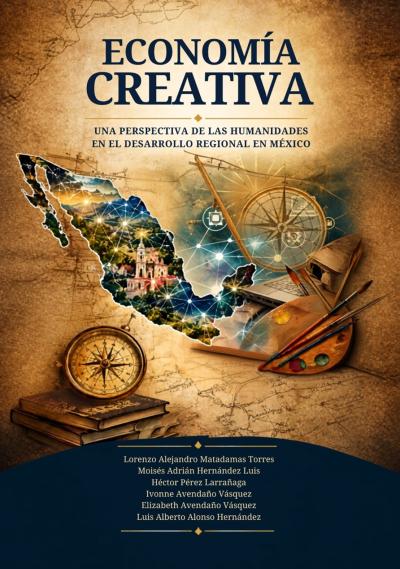
La economía creativa se presenta como una vía para repensar el desarrollo regional en México más allá del PIB y el crecimiento económico, incorporando dimensiones sociales, culturales y humanas. La obra analiza cómo las capacidades humanas, la identidad cultural, el patrimonio biocultural y la innovación social inciden en la transformación de los territorios, y señala las desigualdades en el acceso a educación, tecnología y financiamiento como obstáculos estructurales al desarrollo.
A partir de este diagnóstico, plantea la necesidad de políticas públicas con indicadores de bienestar, equidad y sostenibilidad, en las que las humanidades cumplen un papel estratégico en la construcción de identidad y capital social, mientras la economía creativa impulsa la diversificación productiva a partir de los recursos culturales del territorio. La obra cierra proponiendo una agenda de desarrollo regional basada en la articulación entre Estado, academia, sector productivo y comunidades, orientada a modelos más equitativos y centrados en el bienestar humano.
Araki, S. (2021). Does education make people happy? Spotlighting the overlooked societal condition. Journal of Happiness Studies, 23(2), 587–629. https://doi.org/10.1007/s10902-021-00416-y[cite: 2]
Booi, L., Fitjar, R. D., & Rodríguez-Pose, A. (2021). Social capital and economic growth in the regions of Europe. Environment and Planning A: Economy and Space, 53(6), 1412–1434. https://doi.org/10.1177/0308518X211000059[cite: 2]
Burger, M. J., Morrison, P. S., Hendriks, M., & Hoogerbrugge, M. M. (2022). Urban-rural happiness differentials across the world. En World Happiness Report 2022 (pp. 67–92). Sustainable Development Solutions Network.[cite: 2]
Collins, B. (2020). Putting culture on the map: Media discourse and the urban growth machine in Koreatown, Los Angeles. Urban Affairs Review, 56(1), 254–288. https://doi.org/10.1177/1078087418762505[cite: 2]
Dong, X., & Pan, Y. (2024). Digital economy, regional innovation capacity, and high-quality economic development. Journal of Knowledge Management, 28(3), 712–735. https://doi.org/10.1108/JKM-05-2023-0412[cite: 2]
Fanning, A. L., O'Neill, D. W., & Hickel, J. (2024). The social and ecological boundaries of a sustainable wellbeing economy. Ecological Economics, 215, 108028. https://doi.org/10.1016/j.ecolecon.2023.108028[cite: 2]
Fioramonti, L., Coscieme, L., Costanza, R., Kubiszewski, I., Trebeck, K., Wallis, S., Roberts, D., Mortensen, L. F., Pickett, K. E., Wilkinson, R., Ragnarsdottír, K. V., McGlade, J., Lovins, H., & De Vogli, R. (2022). Wellbeing economy: An effective paradigm to mainstream post-growth policies? Ecological Economics, 192, 107261. https://doi.org/10.1016/j.ecolecon.2021.107261[cite: 2]
Gaucher, R., Dialga, I., & Vennin, C. (2021). The indicator of a happy, long and sustainable life. Social Indicators Research, 159(1), 55–75. https://doi.org/10.1007/s11205-021-02727-2[cite: 2]
González Bernal, V. M., Orozco Espinosa, P., Hernández Guerrero, F., & Meza Gómez, J. I. (2025). La política pública desde la perspectiva de los derechos sociales en México: Un análisis teórico-metodológico y de resultados (2000-2021). Prisma ODS, 4(2), 1–24. https://doi.org/10.65011/prismaods.v4.i2.96[cite: 2]
Hale, J., Irish, A., Carolan, M., Clark, J. K., Inwood, S., Jablonski, B. B. R., & Johnson, T. (2023). A systematic review of cultural capital in U.S. community development research. Journal of Rural Studies, 103, 103113. https://doi.org/10.1016/j.jrurstud.2023.103113[cite: 2]
Halfon, N., Chandra, A., Cannon, J. S., Gardner, W., & Forrest, C. B. (2022). The Gross Developmental Potential (GDP2): A new approach for measuring human potential and wellbeing. BMC Public Health, 22(1), 1626. https://doi.org/10.1186/s12889-022-14030-x[cite: 2]
Hanushek, E. A., & Woessmann, L. (2020). Education, knowledge capital, and economic growth. En The Economics of Education (pp. 171–182). Academic Press.[cite: 2]
INPI. (2025). El Plan Nacional de Desarrollo 2025-2030 reconoce a los pueblos indígenas y afromexicanos como sujetos de derecho público. Instituto Nacional de los Pueblos Indígenas, Gobierno de México. https://www.gob.mx/inpi[cite: 2]
Khalil, E. L. (2022). Solving the income-happiness paradox. International Review of Economics, 69(3), 433–463. https://doi.org/10.1007/s12232-022-00398-0[cite: 2]
Mazzucato, M. (2024). The entrepreneurial state and mission-oriented innovation for sustainable development. Penguin Random House.[cite: 2]
McCartney, G., Roy, M., Hearty, W., McMaster, R., Popham, F., Cumbers, A., & Walsh, D. (2023). Culture and wellbeing economies: Strengthening social resilience through cultural participation. Journal of Cultural Economics, 47(4), 615–632. https://doi.org/10.1007/s10824-023-09487-5[cite: 2]
Muringani, J., Fitjar, R. D., & Rodríguez-Pose, A. (2021). Social capital and economic growth in the regions of Europe. Environment and Planning A: Economy and Space, 53(6), 1412–1434. https://doi.org/10.1177/0308518X211000059[cite: 2]
Nussbaum, M. C. (2024). Justice for animals: Our collective responsibility. Simon & Schuster.[cite: 2]
OECD. (2024). OECD Employment Outlook 2024: The net-zero transition and the labour market. OECD Publishing. https://doi.org/10.1787/a1309325-en[cite: 2]
Pérez, A. S. (2023). El concepto de "Humanismo Mexicano" y su valor como categoría histórica. Revista Tlatelolco: Democracia Democratizante y Cambio Social, 2(4), 12–29.[cite: 2]
Perkins, D. D., Ozgurer, M. R., Lupton, A., & Omidvar-Tehrani, S. (2021). Well-being as human development, equality, happiness and the role of freedom, activism, decentralization, volunteerism and voter participation: A global country-level study. Frontiers in Psychology, 12, 745818. https://doi.org/10.3389/fpsyg.2021.745818[cite: 2]
Plan Nacional de Desarrollo. (2025). Plan Nacional de Desarrollo 2025-2030. Gobierno de la República Mexicana, Diario Oficial de la Federación.[cite: 2]
PNUD. (2025). Human Development Report 2023/2024: Breaking the gridlock: Reimagining cooperation in a polarized world. Programa de las Naciones Unidas para el Desarrollo. https://hdr.undp.org[cite: 2]
Poole, L. A. R., & Appler, D. R. (2020). Building a local preservation ethic in the era of urban renewal: How did neighborhood associations shape historic preservation practice in Lexington, Kentucky? Journal of Urban History, 46(2), 383–405. https://doi.org/10.1177/0096144218816650[cite: 2]
Riely, A. (2020). Gentrifiers, distinction, and social preservation: A case study in consumption on Mount Pleasant Street in Washington, DC. Urban Studies, 57(12), 2383–2401. https://doi.org/10.1177/0042098019830895[cite: 2]
Roberts, A. R. (2020). Preservation without representation: Making CLG programs vehicles for inclusive leadership, historic preservation, and engagement. Societies, 10(3), Article 60. https://doi.org/10.3390/soc10030060[cite: 2]
Rodríguez Miranda, A., Vial Cossani, C., & Parrao, A. (2021). Índice compuesto y multidimensional de desarrollo regional: Una propuesta para América Latina. Revista Iberoamericana de Estudios Municipales, 23, 1–30. https://doi.org/10.32457/riem.v23i1.580[cite: 2]
Rodríguez-Pose, A. (2020). The rise of populism and the revenge of the places that don’t matter. Economic Geography, 94(1), 189–209. https://doi.org/10.1080/00130095.2018.1458196[cite: 2]
Sachs, J., Lafortune, G., Fuller, G., & Drumm, E. (2023). Sustainable Development Report 2023: Implementing the SDG Stimulus. Cambridge University Press. https://dashboards.sdgindex.org/[cite: 2]
Schmit, T. M., Jablonski, B. B. R., Bonanno, A., & Johnson, T. G. (2021). Measuring stocks of community wealth and their association with food systems efforts in rural and urban places. Food Policy, 102, 102119. https://doi.org/10.1016/j.foodpol.2021.102119[cite: 2]
Sen, A. (1999). Development as Freedom. Oxford University Press.[cite: 2]
Sheng, X., & Teng, L. (2025). Digital finance, resource allocation, and regional development disparity. Journal of Financial Stability, 76, 101340.[cite: 2]
Stiglitz, J. E., Fitoussi, J.-P., & Durand, M. (2024). Beyond GDP: Measuring what counts for economic and social performance. OECD Publishing. https://doi.org/10.1787/9789264307292-en[cite: 2]
UNCTAD. (2024). Creative Economy Outlook 2024: Creative industries and sustainable development. United Nations Conference on Trade and Development. https://unctad.org[cite: 2]
UNESCO. (2022). Culture as a global public good: UNESCO World Conference on Cultural Policies and Sustainable Development (MONDIACULT 2022). United Nations Educational, Scientific and Cultural Organization. https://www.unesco.org
UNESCO. (2023). Global Education Monitoring Report 2023: Technology in education. United Nations Educational, Scientific and Cultural Organization. https://www.unesco.org/gem-report
UNICEF. (2024). Child food poverty: Nutrition deprivation in early childhood. UNICEF. https://data.unicef.org
van den Bergh, J. C. J. M. (2022). A procedure for globally institutionalizing a ‘beyond-GDP’ metric. Ecological Economics, 192, 107257. https://doi.org/10.1016/j.ecolecon.2021.107257.
Yang, X. (2023). Human capital, social networks and territorial innovation in knowledge-based regional development. Regional Studies, 57(8), 1452–1467. https://doi.org/10.1080/00343404.2023.2187654.
Zhang, L., Zhang, X., Huang, Y., & Hu, Z. (2024). The convergence of education, technology, and finance for regional innovation capacity in emerging markets. Technological Forecasting and Social Change, 198, 122980. https://doi.org/10.1016/j.techfore.2023.122980.
Instituto Nacional de Salud Pública. (2024). Encuesta Nacional de Salud y Nutrición Continua 2023: Resultados nacionales. Instituto Nacional de Salud Pública. https://ensanut.insp.mx/encuestas/ensanutcontinua2023/informes.php

Esta obra está bajo una licencia internacional Creative Commons Atribución-NoComercial-CompartirIgual 4.0.
No es necesario que cumpla con la licencia para los elementos del material que sean de dominio público o cuando su uso esté permitido por una excepción o limitación aplicable .
No se ofrecen garantías. La licencia podría no otorgarle todos los permisos necesarios para el uso previsto. Por ejemplo, otros derechos, como los de publicidad, privacidad o morales, podrían limitar el uso del material.